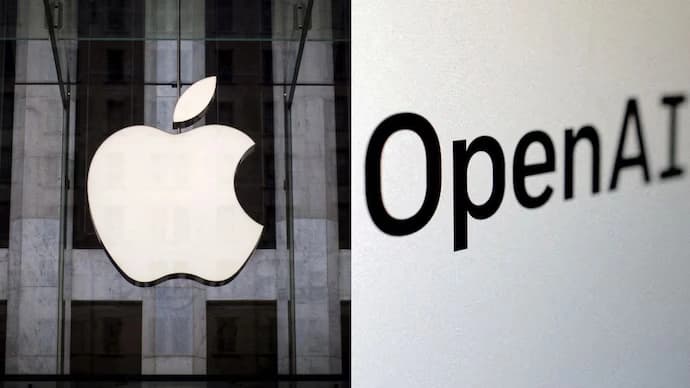
Apple Sues OpenAI Over Alleged Theft of Trade Secrets to Fuel Hardware Ambitions
Apple alleges OpenAI used confidential information and former executives to fast-track its AI hardware plans.
 Staff WriterJul 13, 2026, 1:52 PM
Apple has filed a lawsuit against OpenAI and two former senior employees, alleging they misappropriated the technology giant's trade secrets to support the ChatGPT maker's expansion into consumer hardware, marking a dramatic escalation in tensions between the two companies.
Filed on Friday, the complaint alleges that OpenAI orchestrated a systematic effort to obtain and exploit Apple's confidential information through former employees, recruitment practices and supplier relationships in order to accelerate its hardware ambitions.
"We have no interest in other companies' trade secrets," OpenAI said in a statement. "We remain focused on building innovative technology that empowers people everywhere."
The case could shape the future of AI-powered consumer devices that may eventually replace traditional smartphones and app-based operating systems. Analysts believe OpenAI is developing its own AI-powered device, potentially positioning it as a direct competitor to Apple's iPhone.
The dispute underscores the growing rivalry between the two technology companies as competition intensifies for AI talent, proprietary technology and next-generation consumer devices.
"Apple sees OpenAI moving from partner to potential rival, while OpenAI is trying to reduce its dependence on the iPhone and build a direct relationship with consumers," said PP Foresight analyst Paolo Pescatore. "Even if the allegations are not proven, the lawsuit could delay OpenAI's hardware ambitions and further weaken what is already becoming an increasingly fragile partnership."
The lawsuit, filed in the US District Court for the Northern District of California, comes shortly after OpenAI successfully defended itself against a legal challenge brought by Elon Musk's xAI.
The two former Apple employees named as defendants are Chang Liu, a former senior systems electrical engineer, and Tang Yew Tan, Apple's former vice-president of product design for the iPhone and Apple Watch. Neither immediately responded to requests for comment.
Apple alleges that Liu failed to return a company-issued laptop and later exploited an authentication flaw to access Apple's internal network, downloading dozens of confidential hardware-related files.
The company also claims that Tan, now OpenAI's hardware chief, systematically used Apple's confidential information to benefit OpenAI before leaving the company. According to the complaint, he emailed himself information relating to Apple suppliers and internal industry summaries. Tan spent most of his 24-year career at Apple working on the iPhone, according to his LinkedIn profile.
Apple further alleges that Tan encouraged prospective OpenAI recruits from Apple to bring hardware components from their workplace to job interviews for "show-and-tell" sessions. The complaint cites one candidate as allegedly saying: "I didn't even know we could take those from the office."
Also named as defendants are OpenAI Foundation, OpenAI Group PBC, the company's commercial arm, and io Products, the hardware start-up acquired by OpenAI.
Confidential Information
Apple says it contacted OpenAI in February to raise concerns that its confidential information had been used by the company and requested discussions on the matter, but received no response.
The complaint notes that more than 400 former Apple employees now work at OpenAI, adding that while this is unsurprising, it does not give OpenAI the right to use Apple's trade secrets.
"That OpenAI now employs people who were once entrusted with Apple's trade secrets does not entitle OpenAI to use that information to jump-start its hardware efforts," Apple said in its filing.
Apple also alleges that OpenAI employees sought confidential information from Apple suppliers. In one instance, the company claims a supplier carried out what Apple described as a proprietary metal-finishing technique after believing OpenAI had Apple's permission to use it.
Mark Lemley, a professor at Stanford Law School, said the complaint "has the potential to be a very big case", although he noted that hiring former employees is not illegal in California, where employment laws allow workers to join competitors freely.
"But if Apple's claims that the employees took confidential documents with them — and that OpenAI is using those documents — are true, that is a problem for OpenAI," Lemley said.
Camilla Hrdy, a professor at Rutgers Law School, said the litigation could become particularly complex because most previous AI-related trade secret cases have centred on software rather than hardware.
"These trade secret lawsuits are frequently brought in the tech sector, and we usually learn much more as the case develops. OpenAI is not a defendant that can't afford to defend itself," Hrdy said.
Partnership Under Strain
A person familiar with the matter told Reuters in May that OpenAI had been exploring legal options against Apple, including notifying the company of an alleged breach of contract, although it had not decided whether to file a lawsuit.
Despite the legal dispute, the two companies remain commercial partners. In 2024, Apple integrated OpenAI's ChatGPT into Apple Intelligence, allowing Siri to access ChatGPT responses and enabling iPhone users to subscribe to ChatGPT directly through iOS settings.
Apple also rolled out a long-delayed overhaul of Siri last month, two years after first announcing major AI-powered upgrades that were repeatedly postponed.
Last year, OpenAI strengthened its hardware ambitions by acquiring AI hardware start-up io Products, founded by former Apple designer Jony Ive, in a $6.5 billion deal. Ive is not named as a defendant in Apple's lawsuit.
For any enquiries or information, contact ask@tlr.ae or call us on +971 52 644 3004. Follow The Law Reporters on WhatsApp Channels.