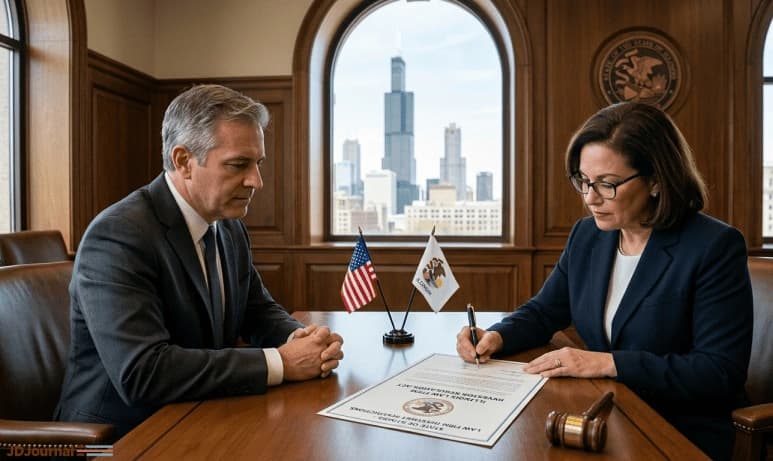
Illinois Moves to Curb Investor Influence Over Law Firms as Lawmakers Pass Sweeping Legal Ethics Bill
Bill seeks to restrict third-party influence over law firms and tighten rules on investor-backed legal business structures.
 Staff WriterJun 2, 2026, 8:57 AM
Illinois, home to one of the largest legal markets in the United States, is poised to introduce new safeguards separating law firms from third-party investors after state lawmakers passed legislation over the weekend aimed at limiting back-office partnerships and other business arrangements involving outside capital.
The Illinois Senate on Saturday voted 39-19 in favour of an amended version of House Bill 5487, which was subsequently approved by the Illinois House on Sunday by a vote of 75-39. The bill will now be sent to Democratic Governor JB Pritzker for consideration.
A spokesperson for the governor’s office did not immediately respond to a request for comment.
If signed into law, the legislation would prohibit any entity involved in a law firm’s operations, but not wholly owned by lawyers, from interfering with attorneys’ professional judgment, controlling hiring decisions or accessing client documents. Such entities would also be barred from charging fees “directly or indirectly” linked to a law firm’s fees, revenue or profits.
The bill is largely aimed at law firm management services organisations (MSOs), as well as legal providers operating as “alternative business structures” in other states. Similar legislation is currently pending in California and Colorado.
Investors and other non-lawyers are generally prohibited from owning direct stakes in US law firms or sharing in legal fees. MSOs, however, can provide capital to law firms and generate returns for investors without breaching those restrictions. Under such arrangements, a law firm spins off non-legal back-office functions, such as human resources or marketing, into an MSO that may be wholly or partly owned by outside investors. The law firm then pays the MSO from its revenues without directly sharing legal fees.
Under the Illinois bill, lawyers would also be required to disclose any agreements they have with MSOs to their clients.
Since its introduction, lawmakers have amended House Bill 5487 five times. The version passed by both chambers of the Illinois General Assembly applies only to lawyers and law firms with annual revenue below $300 million or firms that have derived more than 50 per cent of their revenue from contingency fees during the past three years.
“Private equity companies are starting to get creative with how they influence law firms,” State Senator Michael Hastings, one of the bill’s chief sponsors, said in a statement following the Senate vote on Saturday. “It is time for Illinois to act decisively and shut down this loophole that is being abused.”
The legislation has received backing from the Illinois Trial Lawyers Association, Illinois Defense Counsel and the Illinois State Bar Association, which describes itself as the state’s largest bar organisation with around 30,000 members.
The amended version of the bill has, however, been opposed by the Illinois Venture Capital Association. David Stricklin, a lobbyist for the group, said the legislation had been “improved significantly from its introduced versions” and now “provides a roadmap for investors who may have an interest in working with law firms in the future”.
Stricklin added that it appeared “likely” Governor Pritzker would sign the bill into law given the strong support it received in the Illinois General Assembly.
The proposal has also faced opposition from the International Legal Finance Association. A spokesperson for the group did not immediately respond to a request for comment.
For any enquiries or information, contact ask@tlr.ae or call us on +971 52 644 3004. Follow The Law Reporters on WhatsApp Channels.