Can US Government Be Held Accountable for LaGuardia Airport Crash?
Legal experts weigh the potential liability of federal and local authorities after the deadly collision between an Air Canada Express plane and a fire truck.
 Staff WriterMar 26, 2026, 12:37 PM
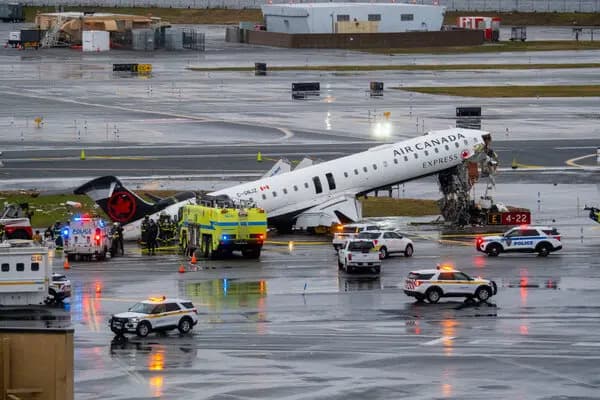
Investigators are examining possible causes of Sunday’s collision between an Air Canada Express plane and a fire truck at LaGuardia Airport in New York, which killed both pilots. Air Canada said 39 of the 76 passengers and crew were hospitalized. The accident has reignited concerns over air traffic control shortages.
A recording from LiveATC.net showed that the controller who cleared Air Canada flight 8646 to land had been trying to find a gate for a United Airlines flight whose crew reported a bad odor that sickened flight attendants. The same controller appeared to have cleared the fire truck to cross the runway. “Stop, truck one, stop,” the controller said shortly after approving passage. In a separate recording, the controller involved said, “I messed up,” blaming himself for dealing with an earlier emergency.
The National Transportation Safety Board has launched an investigation. An NTSB official noted the fire truck lacked a transponder, unlike similar vehicles at other US airports, making it harder for LaGuardia’s warning systems to track its movement.
Can the Government be Sued?
The Westfall Act of 1988 gives federal employees immunity for common law torts committed within the scope of their employment. Negligence is considered such a tort. While the federal government has sovereign immunity from many lawsuits, the Federal Tort Claims Act allows claims for personal injury or death caused by federal employees acting within their employment, including air traffic controllers.
The Port Authority of New York and New Jersey, which operates LaGuardia Airport, can also be sued under state law; two of its officers were in the fire truck.
Claimants have two years to file administrative claims with the FAA, stating injuries, claims, and amounts sought. The FAA has six months to respond; denial allows six months to file a lawsuit. Failure to respond in six months is treated as denial. For the Port Authority, claimants have 90 days to file, must wait 60 days, and can sue within a year.
Possible Claims and Defenses
Claims may include wrongful death, medical expenses, lost wages, emotional distress, and loss of companionship. Lawyers note claims from the LaGuardia accident appear “exceptionally strong,” since pilots expect runway clearance when landing. The FAA may defend that controllers followed manuals or that staffing and employment decisions are discretionary. LaGuardia had 33 controllers on duty, below the target of 37, though officials said it was adequately staffed.
Other Cases
The FAA faced a $6.55 million lawsuit in 2019 after John Brown died in a 2016 Reno-Tahoe crash. The 9th US Circuit Court found the controller failed to ensure visual separation. Brown’s family later settled with the FAA without admission of liability.
At least 34 lawsuits followed the January 2025 collision of American Airlines flight 5342 with an Army helicopter over the Potomac, killing 67. The government blamed the Army pilots’ failure to maintain vigilance, but the NTSB found “degraded controller performance and situation awareness” contributed to the accident.
For any enquiries or information, contact ask@tlr.ae or call us on +971 52 644 3004. Follow The Law Reporters on WhatsApp Channels.