What UAE Aviation Law Says on Cancelled Flights, Passenger Rights, Refunds and Force Majeure in the 2026 Disruption
An updated guide to what airlines must provide, when compensation applies, and how recent policy measures affect travellers.
 AyushiMar 23, 2026, 1:23 PM
On 28 February 2026, the General Civil Aviation Authority (GCAA) temporarily shut the country’s airspace as a precaution amid escalating regional tensions. Although restrictions have since eased, the after-effects continue to ripple across the aviation sector. Airlines are still operating reduced schedules, rerouting flights to avoid conflict zones, and working through a backlog that has disrupted travel plans for thousands of passengers across key hubs.
For travellers caught in the disruption — or those advising them — the legal position is clearer than it may appear. Even in extraordinary circumstances, airlines do not simply walk away from their obligations.
What UAE rules guarantee immediately
At the domestic level, the UAE’s Passenger Welfare Programme sets out the baseline of what airlines must provide when flights are delayed or cancelled. The obligations escalate with the length of the delay. In shorter disruptions, passengers are entitled to meals and refreshments. As delays extend, airlines must facilitate communication and, where necessary, arrange hotel accommodation and transport. If a flight is cancelled, the passenger has the right to choose between a full refund or rebooking at no additional cost.
These are enforceable regulatory duties, not goodwill gestures. Where airlines fail to comply, complaints can be escalated to the GCAA’s Consumer Protection Unit.
When financial loss can be claimed
Beyond immediate care, the UAE Commercial Transactions Law provides a pathway for passengers who suffer financial loss. Its Air Carriage provisions make airlines liable for damage caused by delay, but the key requirement is proof. Missed hotel bookings, forfeited event fees or disrupted onward travel arrangements may fall within its scope.
The law also allows flexibility on where claims can be filed and gives passengers up to two years from the date of travel to initiate proceedings.
How international law limits liability
For international journeys, the Montreal Convention applies. It sets a compensation ceiling for delay-related claims at roughly $7,000. However, airlines can avoid liability if they demonstrate that the disruption was caused by extraordinary circumstances beyond their control.
A government-ordered airspace closure linked to regional instability is almost certain to meet that threshold. Even so, the airline’s duty of care remains. Passengers must still be assisted with rebooking, provided with information, and supported with basic welfare.
Where EU and UK rules fit in
European and UK passenger protection regimes may also apply depending on the route. Flights departing from the EU or the UK, or operated by European carriers into those jurisdictions, fall within EU261 or its UK equivalent.
These rules guarantee care regardless of the reason for disruption, although airlines can rely on the extraordinary circumstances defence to avoid paying fixed compensation. In practice, what determines coverage is the point of departure rather than the airline’s nationality.
Airlines adapt to prolonged disruption
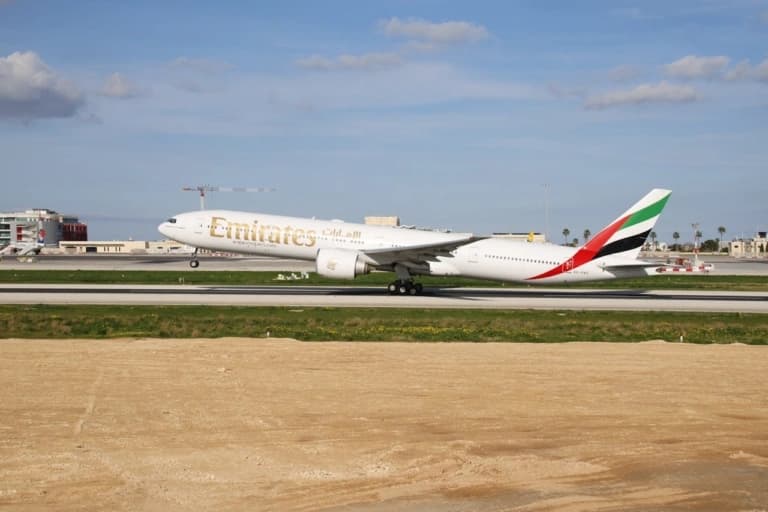
Carriers have introduced flexible measures to manage ongoing uncertainty. Emirates and Etihad Airways have expanded rebooking windows and are processing refunds for affected passengers. Flydubai and Air Arabia continue to operate reduced schedules, with longer journey times due to rerouting.
Alongside this, UAE authorities have stepped in with temporary support measures, including accommodation, meals and transport for stranded passengers — an intervention that goes beyond standard legal requirements.
Force majeure: what it really means
Force majeure is central to the current situation. Airlines are broadly justified in invoking it, as a precautionary airspace closure triggered by regional instability is a classic example of an extraordinary circumstance.
However, its legal effect is often misunderstood. It does not eliminate passenger rights; it limits them. Airlines may be exempt from paying fixed compensation, but they must still provide care, offer refunds or rebooking, and take reasonable steps to minimise disruption. Under international law, they must also show that they did everything reasonably possible to mitigate the impact.
Workarounds and policy relief measures
Recent developments have shaped how passengers are navigating the disruption. One notable workaround is the land-air route via Oman, with some travellers crossing by road to Muscat International Airport to access less restricted airspace, despite long border delays.
On the regulatory side, the Federal Authority for Identity, Citizenship, Customs and Ports Security has introduced temporary flexibility for residents stranded abroad. Those whose permits expired on or after February 28, 2026 have been allowed to re-enter without penalties, easing a key concern for affected travellers.
What passengers should keep in mind
In practical terms, documentation is critical. Keeping receipts for accommodation, meals and transport can support reimbursement claims. Passengers are also advised not to cancel bookings independently, as this may affect entitlement to refunds or rebooking. Communication should be maintained directly with the airline, and any commitments should be recorded.
Rights remain, even in crisis
The broader takeaway is that even in a disruption of this scale, passengers are not without protection. The combined effect of UAE regulation, domestic law and international conventions ensures a baseline of care and, in some cases, compensation.
With full operational recovery still uncertain, travellers should monitor airline updates closely and confirm flight status before heading to the airport. If an airline fails to meet its obligations, you can report the issue to the GCAA, which can step in to ensure your rights are respected.
For any enquiries or information, contact ask@tlr.ae or call us on +971 52 644 3004. Follow The Law Reporters on WhatsApp Channels.