US–Iran War Clock Ticks Louder: Legal Deadline Tightens Pressure on Trump
War Powers Resolution deadline intensifies legal and political pressure, exposing Republican divisions as May 1 approaches.
 Staff WriterApr 24, 2026, 10:32 AM
As the United States moves closer to a critical May 1 deadline in its conflict with Iran, a decades-old statute is no longer a procedural footnote but a central force shaping the trajectory of the war. What began as a military response is now colliding with constitutional limits, turning the spotlight onto the balance of power between the White House and Congress.
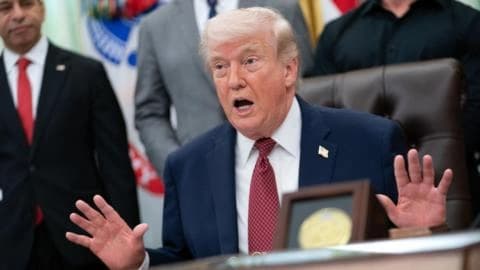
Nearly eight weeks after Washington joined Israeli strikes, President Donald Trump faces a defining choice: continue military operations without congressional approval and risk a political and legal backlash, or seek authorisation and open the door to divisions within his own party. The dilemma underscores a deeper institutional tension that has long simmered in US foreign policy.
At the heart of the moment is the 1973 War Powers Resolution — legislation designed to restrain a president’s ability to conduct prolonged military campaigns without legislative consent. Frequently challenged and often sidestepped, the law’s timelines are now converging with the realities of a conflict that has already reshaped regional security, including the stability of the Gulf and global energy flows.
According to The New York Times, the administration formally notified Congress on March 2, triggering a 60-day countdown that expires on May 1 — a deadline that is fast becoming a legal and political inflection point.
A Legal Clock with Political Consequences
Under the War Powers Resolution, a president can deploy US forces into hostilities without congressional approval for up to 60 days. Beyond that, lawmakers must either authorise the action or the administration must begin withdrawing forces.
Trump initially justified the strikes as necessary to protect US bases and “advance vital United States national interests,” framing the move as part of “collective self-defense” alongside regional allies, including Israel.
Democrats have consistently disputed that rationale, arguing the president acted without legal authority. Their efforts to force a vote under the law have so far been blocked by Republicans — but the approaching deadline could alter that calculus.
Republican Unity Begins to Fray
Until now, Republican lawmakers have largely shielded the administration from attempts to curtail the war. That unity, however, is showing signs of strain.
Senator John Curtis of Utah has publicly stated he “will not support ongoing military action beyond a 60-day window without congressional approval.” Representative Brian Mast, who chairs the House Foreign Affairs Committee, has also indicated that the political equation could shift after the deadline, warning of “a different vote count after 60 days.”
These signals are significant. They suggest that the broad latitude the White House has enjoyed may narrow sharply once the legal threshold is crossed — particularly if the conflict continues without clearly defined objectives or timelines.
Limited Options After May 1
If the deadline passes without congressional authorisation, the administration faces three options: seek approval from Congress, begin withdrawing US forces, or invoke a one-time 30-day extension.
That extension, however, is narrowly defined. It is intended only to facilitate a safe withdrawal, not to prolong offensive operations. This constraint limits the administration’s ability to sustain the conflict under procedural cover, reinforcing the law’s underlying intent.
The Uncertain Path to Authorisation
Congress retains the power to approve the war through an Authorisation for the Use of Military Force (AUMF). In practice, however, that path remains uncertain.
While Republicans have blocked Democratic efforts to end the conflict, formal authorisation would require lawmakers to publicly endorse the war and assume political ownership of its costs and consequences. That is a far more difficult proposition.
Senator Lisa Murkowski of Alaska is reportedly exploring a potential authorisation framework, though no legislation has been introduced. Her efforts reflect growing unease among some lawmakers over the absence of clarity on the war’s objectives, costs and duration — and point to a broader attempt by Congress to reassert its role after decades of ceding ground to the executive.
Testing the Limits of the Law
History suggests the administration may seek to bypass the deadline altogether. Successive presidents have questioned the constitutionality of the War Powers Resolution, arguing that the commander-in-chief retains broad authority over military operations.
In 2011, President Barack Obama continued US involvement in Libya beyond the 60-day limit, arguing the law did not apply because American forces were not engaged in sustained combat. Trump has similarly challenged such constraints in the past, vetoing a bipartisan resolution in 2019 aimed at ending US involvement in Yemen.
A comparable argument could now be deployed — particularly if operations in Iran are framed as limited or defensive in nature.
The Political Weight of the Deadline
Even if legally contested, the 60-day mark carries substantial political significance. Lawmakers who have previously cited the timeline as a meaningful constraint may find it harder to ignore once it is breached.
“Many Republicans are on record having set the 60-day mark as somehow legally important,” said Senator Chris Murphy, a leading Democratic critic of the war. “It will be harder for Republicans to look the other way once we are beyond it.”
Such pressure could trigger a more fragmented debate in Washington, complicating decision-making at a critical stage of the conflict.
Beyond Washington: Regional and Global Stakes
While the legal battle is unfolding in Washington, its consequences extend far beyond US domestic politics. The conflict has already underscored vulnerabilities in energy infrastructure and heightened risks around the Strait of Hormuz — a critical artery for global oil and gas supplies.
Uncertainty in US policy — whether over escalation, de-escalation or withdrawal — directly affects countries reliant on stable security guarantees and uninterrupted maritime flows. A prolonged legal and political standoff could translate into delayed military decisions, mixed signals to allies and adversaries, and increased volatility in energy markets.
A Narrowing Window
As May 1 approaches, the administration’s room for manoeuvre is shrinking. Seeking congressional approval risks exposing internal divisions. Withdrawing forces could project strategic hesitation. Ignoring the law may provoke political backlash at home and uncertainty abroad.
For now, the most plausible path appears to be a calibrated balancing act — sustaining military pressure while avoiding a decisive legal or political confrontation. But that strategy is inherently fragile and difficult to sustain.
What Comes Next
The coming weeks will test not only the durability of US war powers law but also the cohesion of political support for the conflict — and, by extension, the credibility of US commitments in the Gulf.
At stake is more than a statutory deadline. It is a fundamental question about the limits of executive power in wartime — and how long the United States can sustain a military campaign without a clear and explicit mandate in an increasingly volatile region.
For any enquiries or information, contact ask@tlr.ae or call us on +971 52 644 3004. Follow The Law Reporters on WhatsApp Channels.