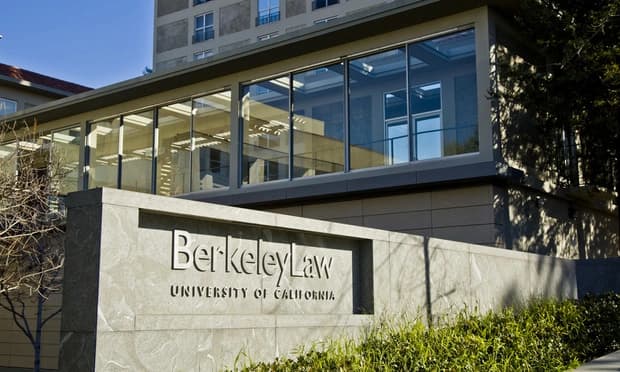
Berkeley School of Law Tightens AI Curbs as Debate Grows Over Chatbots and the Future of Legal Education
Revised policy bans students from using AI tools for brainstorming, grammar correction and legal summaries.
 Staff WriterMay 27, 2026, 10:17 AM
Starting this summer, students at the University of California, Berkeley School of Law will be barred from using artificial intelligence to brainstorm paper topics, generate exam outlines, summarise legal rules for use in papers, or even correct grammatical mistakes in assignments, among several other restrictions.
The new policy — unveiled on Thursday — replaces a more lenient set of AI rules adopted by Berkeley in 2023. It comes amid a growing debate within legal education over how far universities should go in embracing or restricting AI, and whether the rapidly evolving technology is undermining students’ development of foundational legal skills.
Critics of Berkeley’s revised policy argue that it prohibits too many legitimate uses of AI at a time when legal employers increasingly expect newly qualified lawyers to understand and use the technology. University of Houston law professor Seth Chandler described Berkeley’s approach to AI in legal education as “awful” on his blog, calling it an “institutional attempt to recover the world of 2018” before AI became mainstream.
Chandler told Reuters that law students should be allowed to use AI to “understand doctrine, generate hypotheticals, test arguments and prepare for class”.
Supporters of the policy, however, argue that students must first master core lawyering skills and legal judgment before relying on AI tools. They also warn that many students are not yet sophisticated enough to identify the technology’s pitfalls, including its tendency to “hallucinate” legal cases that do not exist.
Florida International University law professor Howard Wasserman wrote on PrawfsBlawg, a blog for legal educators, that Berkeley Law’s policy “should be the model for us all”. In an interview, Wasserman said the revised policy “recognises that AI is not a substitute for the thinking that goes into legal analysis and writing”.
Law schools have generally taken a cautious approach to AI since the launch of ChatGPT in 2022, although a growing number now include AI training in orientation programmes, compulsory first-year courses and upper-level electives. Students are also forming AI clubs, while some legal AI companies are providing schools and students with free access to their products in an effort to build future customer bases.
Berkeley Law decided to revisit its AI policy last autumn following an increase in academic misconduct cases linked to alleged AI misuse, according to professor Chris Hoofnagle, who drafted both the original and revised versions of the policy.
Hoofnagle said some students would ask AI programmes to correct grammar in a paper, only for the system to return a substantially altered version or even modify quotations. He added that it had become difficult to determine when AI was being used outside approved limits, making the earlier policy hard to enforce.
AI technology has also advanced significantly since 2023, Hoofnagle said, requiring the law school to rethink its approach. As with the earlier version, the revised policy serves as the default framework, although individual professors may still establish their own classroom AI rules. Hoofnagle added that Berkeley Law continues to offer several AI-focused courses where the use of AI tools is permitted.
“Our goal is to make sure that students develop the skills consistent with being a good lawyer,” Hoofnagle said. “I’m nervous about the policy. I’m not sure it’s going to work. But I also know it’s not possible to just ignore the problem.”
For any enquiries or information, contact ask@tlr.ae or call us on +971 52 644 3004. Follow The Law Reporters on WhatsApp Channels.