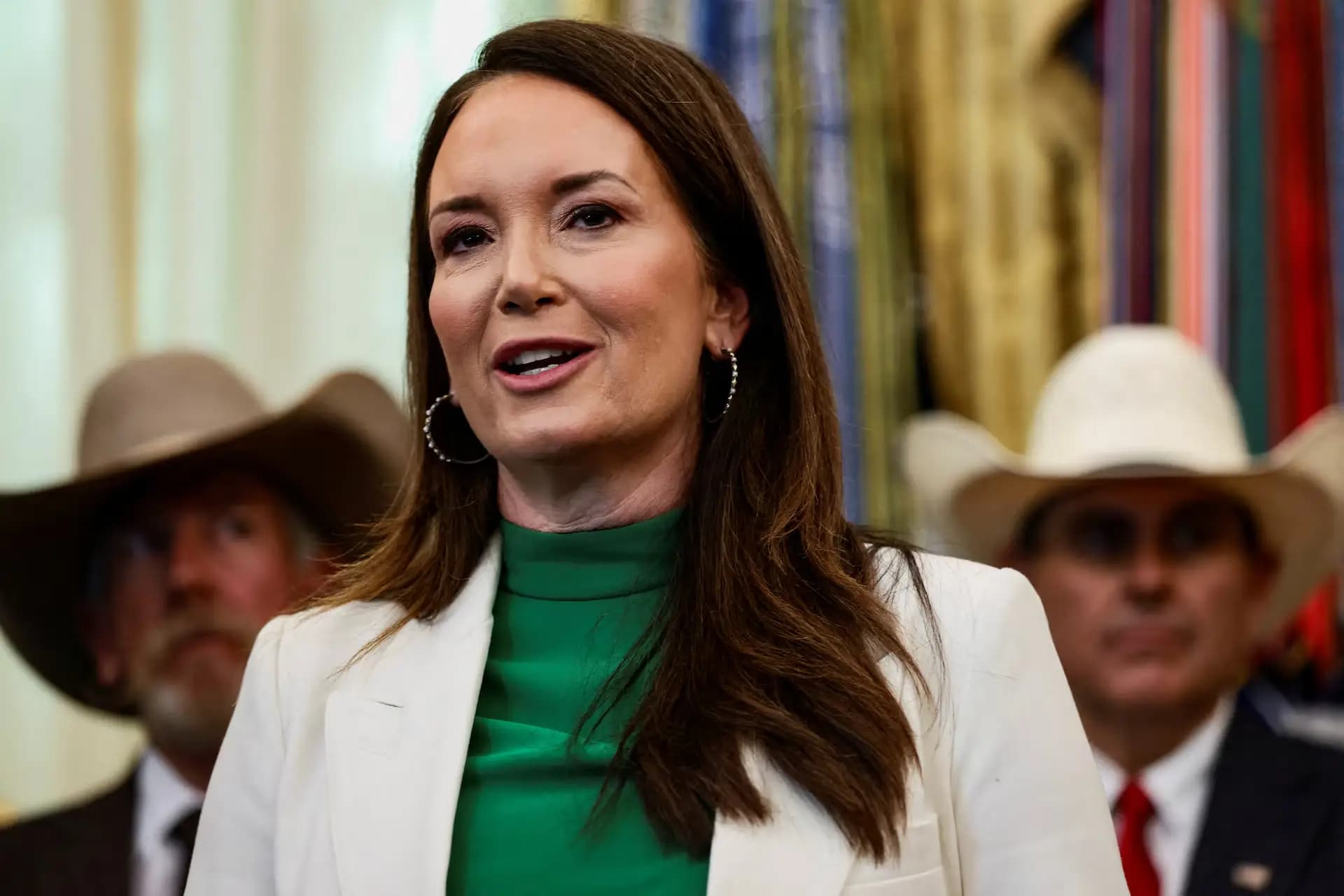

A US federal judge has ordered Agriculture Secretary Brooke Rollins to stop sending religious messages to employees through her official government email account, ruling that her communications must respect constitutional boundaries on the promotion of religion in the workplace.
US District Judge Trina Thompson, in a ruling issued on Thursday, said Rollins must recognise limits when communicating religious messages to employees, particularly where her language appeared to assume that recipients shared her Christian beliefs.
Rollins, who has frequently expressed her Christian faith through official emails and social media posts, faced legal action from federal employees and religious freedom advocates over messages circulated to staff of the US Department of Agriculture (USDA).
The department had argued that the communications reflected Rollins’ personal religious views and celebrations of certain holidays, rather than an attempt to impose religious beliefs on employees or compel them to participate in religious activities.
The USDA said it was considering all available options, including an appeal, describing the ruling as an unprecedented attempt to restrict the freedom of a Cabinet secretary to express her beliefs.
Thompson said the issue was not whether Rollins could practise or discuss her religion in her personal capacity. Rather, the court was concerned with the use of official government communications and the authority attached to her position when addressing subordinate employees.
The judge noted that employees could not realistically avoid reading messages circulated by the head of their department. In that context, the communications risked creating pressure on staff members who did not share her religious beliefs.
The plaintiffs argued that Rollins’ messages created an impression that Christian employees were favoured, while workers belonging to other religions or holding no religious beliefs could feel excluded or pressured to conceal their own convictions.
Their complaint also alleged that supervisors had warned employees that raising objections to the messages could lead to trouble.
In examining the communications, Thompson drew attention to Rollins’ repeated use of words such as 'we', 'us' and 'our'. The judge said the language, combined with the absence of acknowledgement of other religious traditions, could create the impression that the department's workplace culture was expected to reflect the secretary's Christian beliefs.
The court also referred to an Easter message in which Rollins used Christian references to describe the significance of the religious holiday and encouraged employees to share in its spiritual meaning.
The ruling requires Rollins to respect workplace boundaries when communicating religious messages. She must stop if a colleague asks her to do so, must not create a hostile working environment through persistent unwanted religious approaches and must not use her official authority to pressure subordinates.
These requirements were drawn from the USDA's own policy on religious expression in the workplace, which Rollins had adopted.
The judge, however, did not prohibit Rollins from discussing her faith with colleagues who are interested, explaining its importance to her, politely inviting co-workers to religious events or expressing her views in appropriate conversations.
Six USDA employees and the National Federation of Federal Employees, a labour union representing about 19,000 agricultural department workers, filed the lawsuit in May.
The case comes amid wider debate in the United States over the relationship between government institutions and religious expression under President Donald Trump's administration.
Civil rights advocates have raised concerns about the increasing visibility of Christian religious activities within federal institutions. Defence Secretary Pete Hegseth, for example, has incorporated expressions of his Christian faith into activities at the Pentagon.
The First Amendment to the US Constitution protects religious freedom while prohibiting the government from establishing or endorsing a religion. The dispute highlights the legal boundaries between an individual public official's right to religious expression and the responsibility to ensure that government authority is not used to promote particular beliefs among employees.
For enquiries or further information, contact ask@tlr.ae or call +971 52 644 3004. Follow The Law Reporters on WhatsApp Channels.