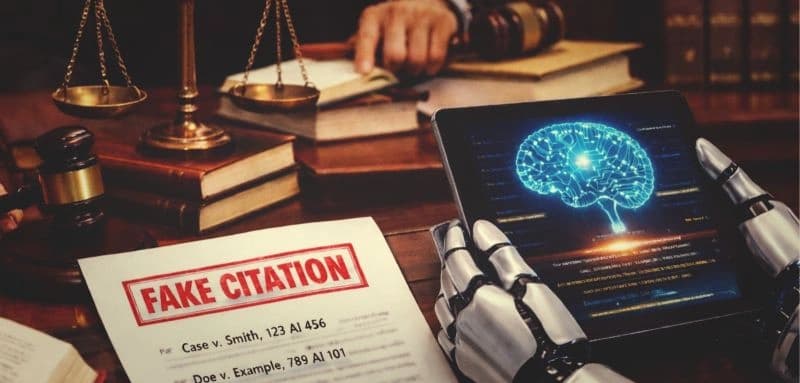
Court Rebukes Deutsche Bank Lawyers Over AI-Generated Fake Case Citations
Court calls the incident a cautionary tale and warns lawyers to verify AI-generated legal material before filing.
 Staff WriterSep 8, 2026, 11:18 AM
The District of Columbia Court of Appeals has criticised lawyers representing a Deutsche Bank subsidiary after they cited non-existent cases in a mortgage foreclosure lawsuit, with the court saying the fabricated authorities appeared to have been generated by artificial intelligence.
The court described the incident as a “cautionary tale” about the misuse of AI by lawyers and stressed that attorneys have a responsibility to check material produced with the technology before submitting it to a court.
The case involved Deutsche Bank National Trust, which was acting as trustee for a securitised mortgage trust. The appeals court, Washington’s highest local court, said it discovered that a brief filed on the bank’s behalf contained several citations to cases that it could not locate or confirm as legitimate.
Outside lawyer Loishirl Hall apologised in a court filing and acknowledged using a Google artificial intelligence programme to help prepare the brief. She said she had taken steps to verify the accuracy of the citations before the document was submitted.
The appeals court said Hall had accepted responsibility for the error, but concluded that every lawyer who signed the brief bore some responsibility for its contents. The court struck the brief and referred the matter to the District of Columbia attorney disciplinary authorities for any investigation they considered appropriate.
Hall’s former firm, McCabe, Weisberg & Conway, told the court that its policy did not permit employees to use AI to draft legal correspondence or documents. Hall, Deutsche Bank and the firm did not immediately respond to requests for comment, according to the report.
The ruling comes as courts across the United States confront a growing number of cases involving lawyers submitting fabricated or inaccurate legal authorities generated by AI. Judges have increasingly warned that lawyers cannot rely on the technology without independently checking its output.
The District of Columbia court said the widespread use of AI in the legal profession meant lawyers could no longer credibly claim ignorance of its risks, including the technology’s tendency to “hallucinate” legal authorities. At the same time, the judges said they did not intend to discourage lawyers from using AI.
Instead, the court emphasised the need for attorneys to use the technology carefully and responsibly, with proper verification of material before it reaches the court.
The ruling also highlighted an emerging issue for law firms and their clients: responsibility for AI-generated errors may extend beyond the individual lawyer who used the technology. The court said that lawyers who signed the filing also had responsibility for its contents.
Judge Stephen Glickman, writing separately, questioned whether striking the brief was an adequate response because the measure could penalise the client for an offence committed by its lawyers. He described the remedy as appropriate but comparatively weak and suggested that the full appeals court might need to consider the issue further.
The case adds to growing judicial scrutiny of the use of generative AI in legal proceedings, particularly where lawyers fail to verify information generated by such systems. Recent cases have seen courts rebuke or sanction lawyers after AI tools produced fictitious case law and other inaccurate material.
The ruling therefore serves as another warning to the legal profession that the use of AI does not remove a lawyer’s professional obligation to ensure that filings are accurate, properly researched and supported by genuine legal authority.
For enquiries or further information, contact ask@tlr.ae or call +971 52 644 3004. Follow The Law Reporters on WhatsApp Channels.