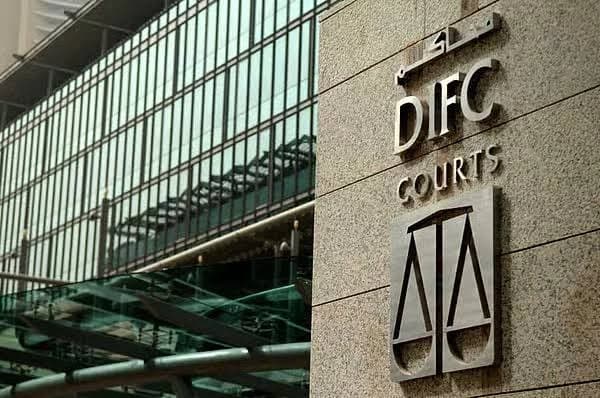
DIFC Courts Attract Cases From 22 Overseas Jurisdictions in H1 2026
243 opt-in cases highlight the Courts’ growing role in cross-border commercial dispute resolution
 Staff WriterAug 20, 2026, 11:52 AM
The Dubai International Financial Centre (DIFC) Courts received 243 opt-in cases during the first half of 2026, accounting for 30% of the 810 cases filed across all divisions.
Of these, 201 cases were filed with the Small Claims Tribunal (SCT), while 42 were filed across the Court of First Instance (CFI), Arbitration Division and Digital Economy Court (DEC). Across the SCT, CFI and DEC, opt-in cases involved UAE-based parties as well as businesses and individuals from 22 overseas jurisdictions spanning five continents.
The figures underline the DIFC Courts’ growing role as a forum for cross-border commercial disputes and highlight the practical role of Dubai’s English-language, common-law commercial court in international dispute resolution, the Courts said.
In addition to their default jurisdiction, the DIFC Courts allow parties to qualifying civil and commercial disputes to opt into their jurisdiction through a written agreement. This option is available to businesses across the UAE, whether or not they are based in the DIFC, as well as to international parties. Parties can opt in through a jurisdiction clause in their contract or a separate written agreement, with no mandatory UAE connection required.
Choosing the DIFC Courts does not alter the governing law of a contract. Parties remain free to agree on the law of their choice, which the Courts will then apply.
Justice Omar Al Mheiri, Director of the DIFC Courts, said: “For businesses operating across borders, the ability to agree a clear and reliable forum for resolving commercial disputes is an important part of doing business with confidence. The H1 figures show that UAE-based and international users are selecting the DIFC Courts for that purpose, including in matters with no UAE-based party. By delivering accessible, digitally enabled and independent commercial justice, we contribute to the confidence businesses need when trading internationally. This confidence supports the ambitions of the Dubai Economic Agenda D33 by reinforcing Dubai’s position as a trusted destination for investment, trade and international business.”
The CFI received 30 opt-in claims in H1 2026. Nearly half (47%) involved at least one party based outside the UAE, with parties from 13 overseas jurisdictions, including Saudi Arabia, Oman, India, Germany, Switzerland, the United States and Australia. In some cases, none of the parties was based in the UAE. The remaining CFI opt-in claims involved UAE-based parties choosing the DIFC Courts.
The Digital Economy Court received one opt-in claim involving parties recorded in the United Kingdom, Saint Vincent and the Grenadines, El Salvador and Vietnam.
The Courts’ international reach was also reflected in the Arbitration Division, where eight of the 11 opt-in cases filed during H1 2026 related to arbitrations seated overseas. These included arbitration hubs such as Singapore, Hong Kong, London, Paris and Stockholm, with parties opting into the DIFC Courts’ jurisdiction in proceedings connected to those arbitrations.
The Courts said the figures demonstrate their role in cross-border dispute resolution, including cases where no party was based in the UAE and proceedings connected to arbitrations seated overseas. The framework is supported by an independent, English-language common-law system and an established enforcement regime.
For enquiries or further information, contact ask@tlr.ae or call +971 52 644 3004. Follow The Law Reporters on WhatsApp Channels.