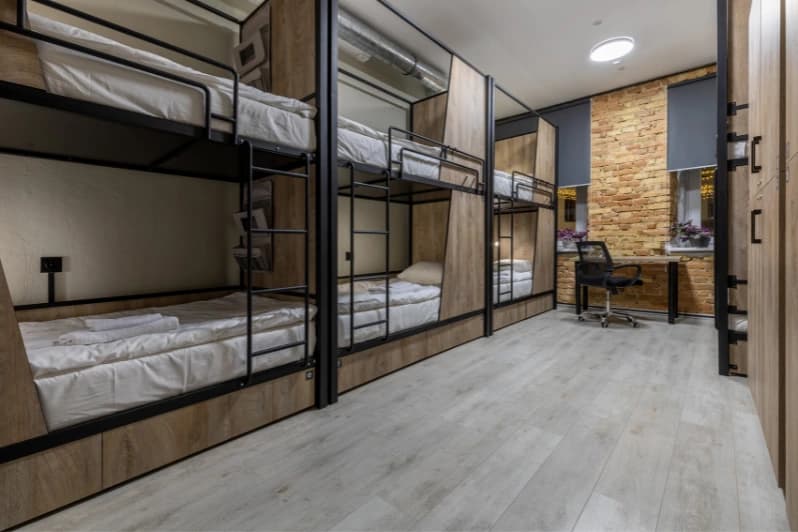
Dubai Shared Housing Law Requires Separate Tenancy Deals for Occupants, Except Labour Accommodation
Law No. 4 of 2026 requires formalising occupants’ designated-space rights, while collective labour accommodation is excluded.
 Staff WriterSep 16, 2026, 11:12 AM
People living in shared accommodation in Dubai are required to have a tenancy agreement covering the space allocated to them, under the emirate’s new law regulating the occupancy and management of shared housing.
Dubai Law No. 4 of 2026 applies to real estate units across the emirate, including properties located in special development areas and free zones. It establishes rules governing owners, landlords, authorised operators and occupants, while setting out requirements intended to regulate shared accommodation and prevent overcrowding and unregulated housing. The law came into force on August 26, 2026.
However, the law specifically excludes real estate units designated for collective labour accommodation from its scope. This means the separate tenancy-contract requirement for individual occupants under the shared housing law does not apply to residents of accommodation falling within the excluded labour housing category.
Separate Agreement For Each Occupant
Under Article 25, a landlord must enter into a tenancy agreement with each occupant of a shared housing unit, register the agreement in the electronic shared housing register and provide the occupant with a copy.
The law defines an occupant as an individual who rents the space allocated to him or her in a shared housing unit for residential purposes under the applicable rules and the tenancy agreement. It also defines a tenancy agreement as the contract between the landlord and occupant under which the landlord allows the occupant to reside in the designated space for an agreed period in return for rent.
The requirement therefore goes beyond a general arrangement under which one person rents an entire property and informally allocates beds or rooms to other residents. Each occupant covered by the law must have a contractual arrangement identifying the space provided for residential use.
The tenancy agreement must also be entered in the shared housing register. The law provides that a tenancy agreement and any amendment to it must be registered to be effective. An unregistered agreement generally cannot be relied upon by the landlord or authorised establishment to exercise contractual rights. However, the law protects a bona fide occupant from the consequences of non-registration and allows such an occupant to enforce the agreement against the owner or establishment, as applicable.
Landlord Responsibilities
The law places a number of obligations on landlords of shared housing. In addition to entering into and registering an agreement with each occupant, the landlord must ensure that the terms of the tenancy or management agreement comply with the conditions and requirements attached to the relevant permit.
The landlord must hand over the designated space on the date agreed in the tenancy agreement and allow the occupant to use it throughout the contractual term in accordance with the agreed conditions. The space must also be in a condition suitable for the intended use and purpose.
The landlord is also required to comply with the maximum occupancy limit specified in the permit and display a sign in a prominent position showing relevant information about the authorised party and the category of shared housing. The law further requires landlords to notify the relevant authority when certain information concerning the owner, establishment or occupants changes.
These provisions are intended to establish a more formal relationship between landlords and individual residents rather than leaving occupants dependent on informal arrangements with other tenants or intermediaries.
Rent And Contract Period
The law requires the tenancy agreement to specify the rental period, with the agreement continuing until the end of that period unless it is terminated in accordance with the law. The parties may renew the agreement by mutual consent.
Rent must also be specified in the tenancy agreement. Unless the parties agree otherwise, the occupant is required to pay rent monthly and in advance.
The law provides that the rent includes charges for electricity and water consumption unless the parties agree otherwise. Where those charges are payable by the landlord, the landlord remains responsible for paying them to the relevant service provider.
This creates a clearer contractual framework for occupants who rent an individual room, bed space or other designated area within a shared property.
Occupants Cannot Sublet
The new law also places restrictions on what occupants can do with their allocated spaces. An occupant may not sublease or otherwise rent out the space allocated to him or her to another person. Any tenancy agreement entered into in violation of this prohibition is considered null and void.
Occupants are also prohibited from using their designated space for purposes other than residential use, allowing another person to reside in or use it, or carrying out economic activities within the shared housing unit.
They must comply with applicable environmental, health and public-safety requirements and take reasonable care of the property and the space assigned to them. They are also prohibited from making alterations, renovations or maintenance works without authorisation.
The restrictions are significant for shared accommodation arrangements in which an existing occupant informally rents out a bed or room to another person. Under the new framework, the right to lease the shared housing unit is restricted to the owner or an authorised establishment.
Labour Camps Remain Excluded
A key distinction under the law is between regulated shared housing and collective labour accommodation. Article 3 expressly excludes real estate units designated for collective labour accommodation from the law. Consequently, the provisions governing individual tenancy agreements under the shared housing regime do not apply in the same manner to residents of accommodation that falls within the collective labour accommodation category.
At the same time, the law covers shared accommodation occupied by individuals or families who are allocated separate spaces while sharing facilities such as kitchens, dining areas, bathrooms and other common areas.
The distinction is important because not every property containing multiple workers or residents will necessarily be treated as collective labour accommodation. The legal classification of the accommodation and the applicable regulatory requirements determine whether the shared housing law applies.
Special Rules For Companies And Students
The law also permits government entities, companies and private institutions to lease shared housing units for their employees and workers, where providing accommodation forms part of their obligations. Educational institutions may similarly arrange shared accommodation for their students, subject to the required permit and applicable standards.
In such cases, employees, workers and students residing in the authorised units may be exempt from entering into individual tenancy agreements.
However, the law still imposes relevant obligations on the organisations providing or allocating the accommodation, as well as on the residents, to the extent appropriate to the nature of the organisation and the occupants.
The framework therefore distinguishes between ordinary shared housing arrangements, where individual occupants generally require tenancy agreements, and specific institutional accommodation arrangements covered by the special provisions of the law.
For ordinary shared housing, the central requirement is clear: an occupant should have a formal tenancy agreement for the space allocated to him or her, and the agreement must be registered in the shared housing register. Collective labour accommodation, however, is expressly excluded from the scope of Law No. 4 of 2026.
For enquiries or further information, contact ask@tlr.ae or call +971 52 644 3004. Follow The Law Reporters on WhatsApp Channels.