Dubai Shared Housing Law: What Residents, Landlords Need To Know
New rules now govern who can live in shared accommodation, how properties can be rented and managed.
 Staff WriterAug 29, 2026, 12:36 PM
Dubai’s new shared housing law has come into force, bringing a comprehensive regulatory framework for a sector that has long operated in a largely informal manner. Dubai Law No. 4 of 2026 on the Regulation of Occupancy and Management of Shared Housing came into effect on August 26, 2026, 180 days after its publication in the Official Gazette.
The law applies across Dubai, including private development zones and free zones, and covers property owners, occupants, licensed establishments and tenancy and management contracts relating to shared housing. Collective labour accommodation is excluded from its scope.
The legislation is intended to regulate shared accommodation, protect the rights of owners and occupants, improve health and safety standards, curb overcrowding and unregulated housing, address building and land-use violations and promote greater fairness in the rental market.
Who Can Live in Shared Housing?
The law specifically identifies six categories eligible for shared housing: families, individual women, individual men, female students, male students, and government employees and workers of private companies and establishments.
However, eligibility for shared housing does not mean that every category can occupy every property. Dubai Municipality has the authority to establish specific standards for each category based on the type of property and can subsequently amend, remove or add categories.
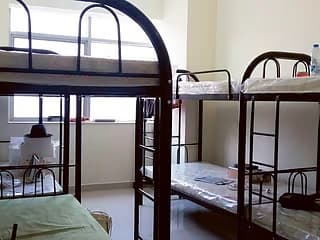
Shared housing is defined as accommodation where individuals or families are allocated designated spaces within a property for residential purposes while sharing facilities and services such as kitchens, dining rooms, bathrooms and outdoor areas.
Which Properties Can Be Used?
The law permits several types of properties to be designated for shared housing, including residential apartments, standalone houses, residential complexes, mixed-use buildings, townhouses and multi-storey buildings.
But a property cannot simply be converted into shared accommodation because an owner or tenant wants to rent out individual spaces. A permit must first be obtained from the relevant authority.
Properties must meet applicable planning and building requirements as well as health, safety, fire prevention, environmental, security and electrical safety standards. Authorities can also determine the maximum number of occupants, the space to be allocated to each occupant and the facilities and services that must be provided.
Permits are Mandatory
One of the central requirements of the new law is that no individual or legal entity may designate a property for shared housing without obtaining the required permit.
The permit is generally valid for one year and can be renewed for similar periods. The relevant authority may, at the owner's request, issue a permit for two years. Applications for renewal must normally be submitted at least 30 days before the permit expires.
The law also regulates who can commercially operate shared housing. Leasing rights are restricted to the property owner and authorised establishments. A licensed establishment may manage a property for the owner or lease the property from the owner and sublease it to occupants.
Tenants Cannot Sublet Their Spaces
The new framework draws a clear line between authorised shared housing and informal subletting. An occupant cannot re-rent the space allocated to them or allow another person to live in and use that space. Any sublease entered into by an occupant is considered invalid under the law.
This means that a person renting a room or designated space in a licensed shared property cannot turn that space into another rental arrangement or commercially accommodate another person without authorisation.
The law does not specifically establish a numerical limit on ordinary social visitors. However, occupants are prohibited from allowing another person to reside in and benefit from their allocated space. The distinction is therefore between a visitor and someone who is effectively occupying the space as a resident.
Rent is Monthly and in Advance by Default
The law establishes monthly advance payment as the default arrangement for shared housing. Under Article 19, the rent must be paid in advance on a monthly basis unless the landlord and occupant agree otherwise in the tenancy contract. This means the monthly payment requirement is a statutory default rather than an absolute prohibition on other payment arrangements.
The rent is agreed in the tenancy contract and includes the occupant’s use of common facilities and services.
Electricity and water consumption charges are also included in the rent by default unless the parties agree otherwise. Even when the parties agree to deal with these charges separately, the landlord remains responsible for paying the relevant utility provider.
Tenancy Contracts Must Be Registered
The law creates a dedicated electronic Shared Housing Registry administered by the Dubai Land Department. Management contracts, tenancy contracts, amendments to those contracts and occupant information must be recorded in the registry. A tenancy contract must be registered to be effective under the law.
Importantly, however, failure to register a contract does not prejudice a good-faith occupant, who may still enforce the tenancy contract against the owner or authorised establishment.
The Dubai Land Department is also responsible for establishing the required information for tenancy and management contracts and developing standard contract templates.
Occupants Get Specific Protections
The law provides several protections for occupants. A change in ownership of a shared housing property does not, by itself, terminate the existing tenancy. The occupant can continue living in the property according to the terms of the existing contract.
An occupant can also terminate the tenancy during its term by giving at least 30 days’ notice, or the longer notice period specified in the contract. Where advance rent has been paid, the occupant may seek its return, subject to a deduction equivalent to one month’s rent.
If the amount due is not returned within 30 days after the request, the occupant may approach the execution judge to seek recovery.
When Can an Occupant Be Evicted?
The law sets out specific circumstances in which an occupant may be required to leave before the tenancy expires. These include failure to pay rent within 30 days of receiving a payment notice, unlawful use of the property, cancellation of the property's permit, a change in approved land use, serious structural problems, demolition or redevelopment requirements and certain circumstances in which the owner seeks to recover the property for personal use or use by a first-degree relative.
An eviction application must be submitted to the execution judge. An interested party can challenge an eviction decision within seven days of being notified, in accordance with the applicable procedures.
Owners and Operators Have Wider Responsibilities
Landlords and authorised operators must comply with the approved occupancy limits and ensure that the property continues to meet the applicable technical and safety requirements.
They must register tenancy contracts, provide occupants with copies of their contracts, maintain the property, carry out required repairs and ensure that no unauthorised alterations or changes of use are made.
They must also provide occupants with rules governing the property and a multilingual guide explaining their rights and obligations, emergency contact details and permitted uses of the accommodation.
Marketing requirements have also been introduced. Advertisements for shared housing must include the approved trade name of the establishment and its permit number. Misleading advertising or advertising a property for a purpose that is not authorised under the permit is prohibited.
What are Occupants Prohibited From Doing?
Occupants must comply with health, environmental and safety requirements and take reasonable care of their allocated space.
They cannot use the space for purposes other than residential accommodation, allow another person to reside in or benefit from it, conduct economic activities from the property or sublet their allocated space.
They must also allow authorised inspectors to enter the property when required for regulatory inspections.
Fines Can Reach Dh1 Million
The new law introduces significant penalties for violations. A breach can attract a fine ranging from Dh500 to Dh500,000. If the same violation is repeated within one year, the fine can be doubled, subject to a maximum of Dh1 million.
Authorities may also suspend an establishment’s activity for up to six months, cancel a permit, coordinate the cancellation of a commercial licence, cut public services from a non-compliant property until the violation is rectified, refuse certain transactions relating to the property and, in appropriate cases, order the evacuation of a non-compliant property.
The law also provides for inspections and enforcement measures, with authorised officials empowered to investigate violations and inspect relevant records and properties in accordance with the law.
Existing Operators Have Time to Comply
The law does not require existing shared housing operators to become compliant overnight. Owners who had already designated their properties for shared housing, as well as establishments already operating in the sector before the law came into force, have one year from August 26, 2026 to bring their arrangements into compliance.
The Director General of Dubai Municipality may extend this period once where necessary.
A More Regulated Shared Housing Market
The new law effectively moves Dubai’s shared housing sector towards a licensed and monitored model. Shared accommodation remains available to a broad range of residents, including families, men, women and students, but its operation is now subject to permits, occupancy standards, registered contracts, safety requirements and regulatory oversight.
For residents, the framework provides clearer contractual rights and protections. For landlords and operators, it introduces greater compliance responsibilities and potentially substantial penalties for violations.
The legislation also gives Dubai Municipality and other competent authorities powers to develop detailed standards and implementing rules, meaning the regulatory framework for shared housing is likely to become more specific as those measures are introduced.
For enquiries or further information, contact ask@tlr.ae or call +971 52 644 3004. Follow The Law Reporters on WhatsApp Channels.