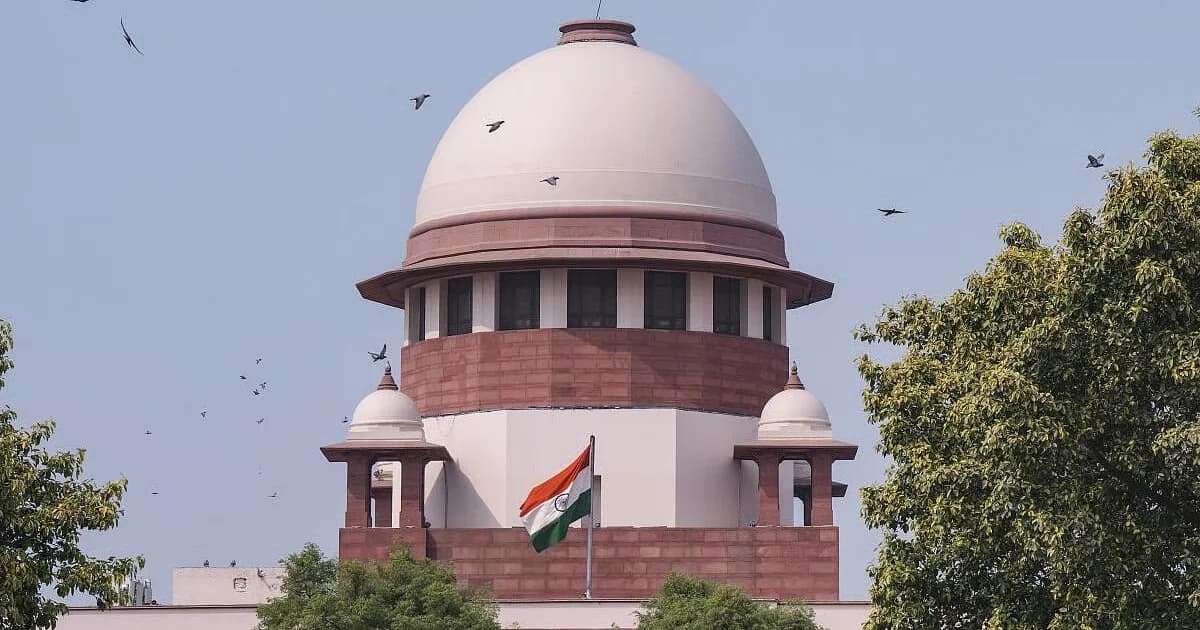

The Supreme Court of India has ruled that a person’s foreign nationality alone is insufficient to trigger the stringent bail restriction under the Unlawful Activities (Prevention) Act (UAPA), clarifying that the provision applies only when the accused’s initial entry into India was illegal or unauthorised.
A Bench of Justices Aravind Kumar and Vipul M Pancholi held that Section 43D(7) of the UAPA cannot be invoked merely because an accused is not an Indian citizen. The provision requires the prosecution to establish that the person entered the country illegally.
“Merely because a person is not an Indian Citizen will not suffice to trigger the rigors of sub-section (7) of Section 43D,” the Court said in Union of India v. Mohamed Rifas.
The Bench clarified that a foreign national’s lawful entry into India does not become illegal retrospectively because their visa or other authorisation is subsequently revoked, expires or their continued stay becomes unlawful.
“What is required and necessary is that when such person entered India initially, such entrance itself was unauthorised or illegal,” the Court observed.
The judgment came on an appeal filed by the Union government against a Madras High Court decision restoring bail to Mohamed Rifas, whom the prosecution alleged was a Sri Lankan national.
The case originated in a 2018 FIR alleging a conspiracy to disturb communal harmony and carry out terrorist acts. Rifas was arrested but obtained default bail in July 2018 after the prosecution failed to file its chargesheet within the prescribed period.
The National Investigation Agency (NIA) subsequently took over the investigation in January 2019 and filed a chargesheet in January 2021.
A separate FIR registered in November 2019 alleged that Rifas had entered India using a Sri Lankan passport, overstayed his visa and unlawfully obtained Indian identity documents.
In April 2022, the prosecution sought cancellation of his bail, contending that he had concealed his foreign nationality and that the restrictions under Section 43D(7) prevented him from remaining on bail.
A special court accepted the prosecution’s plea and cancelled the bail. The Madras High Court overturned that decision in December 2023, prompting the Union government to challenge the ruling before the Supreme Court.
The Supreme Court found that the prosecution had failed to produce material establishing, even prima facie, that Rifas had entered India illegally. It noted that the subsequent FIR itself recorded that he had entered the country on a valid visa and overstayed after it expired.
The Bench also addressed the allegation that Rifas had concealed his foreign nationality, pointing out that his release had originally been secured through default bail after the chargesheet was not filed within the statutory deadline.
Default bail is a statutory entitlement under Section 167(2) of the Code of Criminal Procedure, which applies to UAPA proceedings through Section 43D(2), the Court explained. It held that Section 43D(7) does not override Section 43D(2) and cannot be used to defeat the right to default bail.
The Court further distinguished between setting aside a bail order that is illegal or perverse and cancelling bail because of subsequent misconduct or newly discovered circumstances. It stressed that cancellation must be supported by sound reasons and that courts must exercise the power cautiously, given its direct implications for personal liberty.
The subsequent filing of a chargesheet, the Bench held, does not automatically justify the cancellation of bail. In Rifas’ case, the prosecution had failed to establish any special and compelling ground warranting such a step.
The Supreme Court accordingly dismissed the Union government’s appeal and upheld the Madras High Court judgment restoring Rifas’ bail.
For enquiries or further information, contact ask@tlr.ae or call +971 52 644 3004. Follow The Law Reporters on WhatsApp Channels.