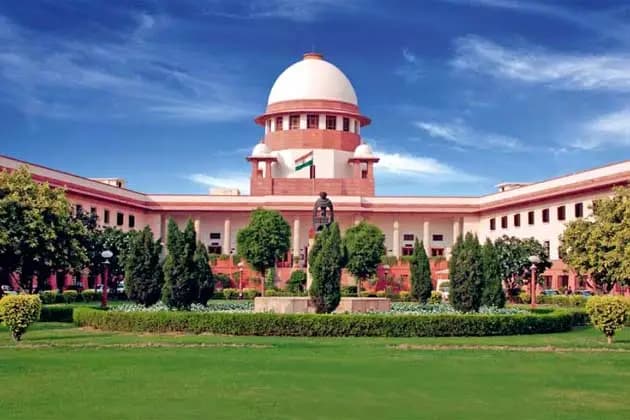
India’s SC Mandates 30% Women’s Representation in State Bar Councils
Top court orders Bar Council of India to ensure women hold at least 30% of council seats and key office-bearer posts.
 Staff WriterDec 5, 2025, 11:05 AM
The Supreme Court on Thursday ruled that women must occupy a minimum of 30 per cent of seats in every State Bar Council across India, directing the Bar Council of India (BCI) to interpret its existing rules accordingly and treat them as amended to reflect this requirement.
A Bench comprising Chief Justice of India Surya Kant and Justice Joymalya Bagchi said the direction aligns with constitutional principles and the country’s broader legislative momentum towards gender equality.
The Court emphasised that the reservation must extend not only to elected seats but also to positions held by office bearers within each State Bar Council.
“Keeping in view the constitutional ethos, the recent legislative initiatives and the orders passed by this Court from time to time, we expect that the Bar Council of India will construe the existing framework in such a manner as to ensure that 30% seats in each State Bar Council are occupied by women members. It goes without saying that such an initiative shall also include some of the posts of the office bearers,” the Bench observed.
The Court further stated that the relevant rules would be deemed to have been amended to incorporate the reservation and directed the BCI to submit full details of its compliance by December 8.
The order was passed during the hearing of two public interest petitions filed by Supreme Court advocates Yogamaya MG and Shehla Chaudhary, who highlighted the stark underrepresentation of women and other marginalised groups in Bar Council governance.
Yogamaya’s petition noted that although the number of women in the legal profession is steadily increasing, their presence in Bar Council leadership remains negligible. Citing Bar & Bench data, the plea revealed that of 441 elected members across 18 State Bar Councils, only nine are women—just 2.04 per cent.
The petition also pointed out that since its formation in 1961, the Bar Council of India has never had a woman member. It argued that this exclusion violates Articles 14, 15, and 16 of the Constitution, and called for structural reforms and mandated quotas for women in upcoming Bar Council elections.
Senior Advocate Shobha Gupta, representing the petitioners, submitted that the current electoral framework under the Advocates Act, 1961, entrenches systemic exclusion. She argued that the term “proportional representation” in Section 3(2)(b) must be interpreted to include gender representation.
The plea further highlighted that the five-phase Bar Council elections scheduled from January to April 2026 -- beginning with Uttar Pradesh and Telangana -- do not include any provision for women’s representation. Without judicial intervention, women would remain excluded for another five-year term.
In a previous order dated November 7, the Supreme Court had also issued notice on a similar petition filed by Chaudhary seeking one-third reservation for women in all State Bar Councils, along with at least one woman office-bearer in each council on a rotational basis.
According to the petition, 11 of the 18 State Bar Councils have no women members, and none of the 20 members of the BCI are women. The petitioner argued that a 98 per cent gender gap cannot be seen as incidental and that only compulsory reservation can address this imbalance.
The matter will be heard next on December 8, when the BCI is expected to present details of the measures taken to implement the Court’s direction.
For any enquiries or information, contact ask@tlr.ae or call us on +971 52 644 3004. Follow The Law Reporters on WhatsApp Channels.