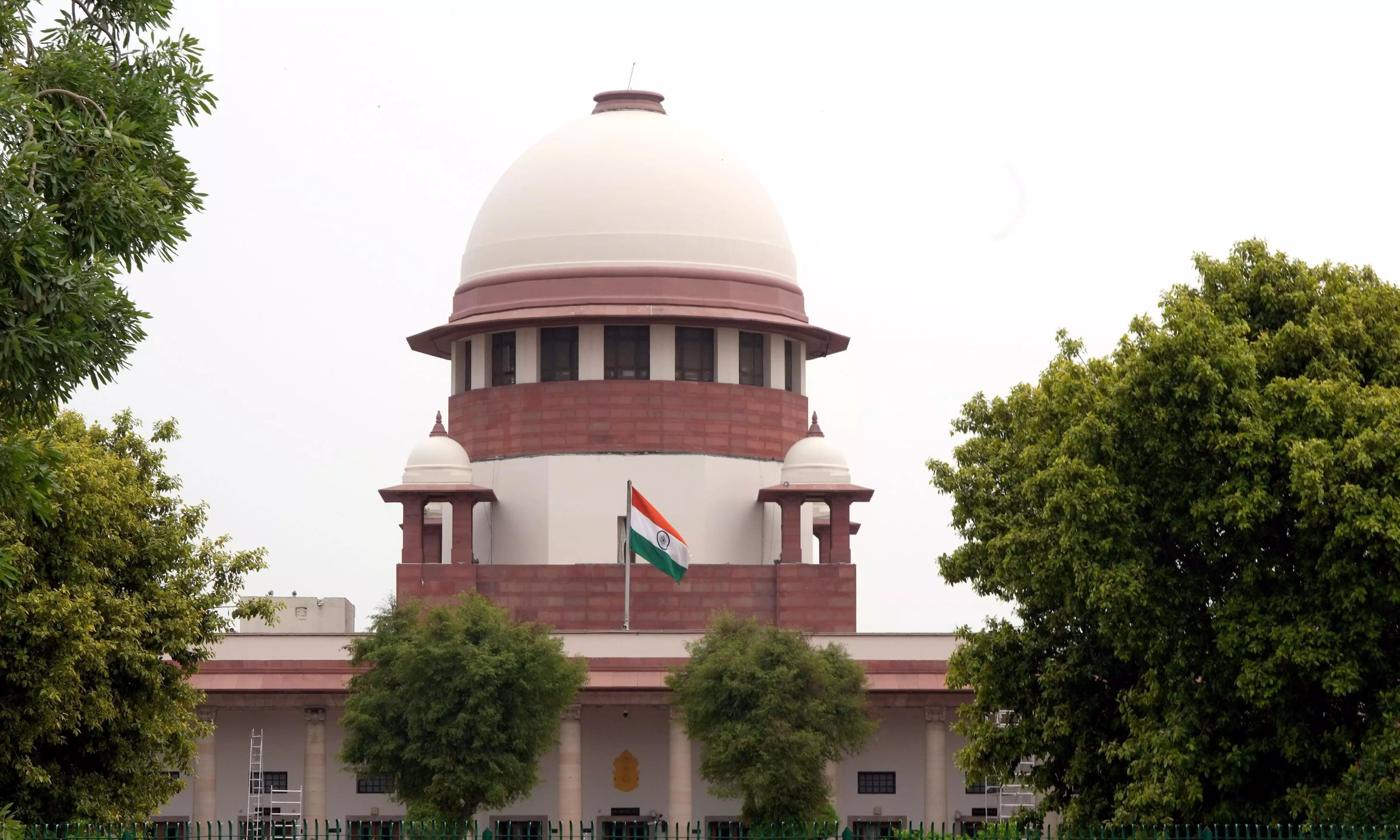
Supreme Court Orders ED SIT, Bars Anil Ambani from Leaving India
Top court directs ED and CBI to fast-track probe into alleged ₹31,580 crore loan fraud, flags possible collusion by bank officials.
 Staff WriterFeb 4, 2026, 10:31 AM
The Supreme Court on Wednesday directed the Enforcement Directorate (ED) to constitute a Special Investigation Team (SIT) to probe allegations of large-scale bank fraud involving Reliance Communications (RCOM), its group entities and industrialist Anil Ambani.
A Bench comprising Chief Justice of India Surya Kant and Justices Joymalya Bagchi and Vipul Pancholi also recorded an undertaking by Ambani’s counsel that he would not leave the country without the court’s permission, amid concerns that he could flee India before the investigation concludes.
“ED is well advised to constitute a SIT comprising senior officers and take all measures to ensure that the ongoing probe is taken to its logical conclusion,” the Bench said while hearing a petition filed by former Union Secretary EAS Sarma seeking a court-monitored investigation.
Senior Advocate Mukul Rohatgi, appearing for Ambani, assured the court that his client would remain in India. Solicitor General Tushar Mehta, however, cautioned against complacency, citing past instances where similar assurances had failed. The court subsequently recorded assurances from both sides that preventive steps would be taken to ensure the probe is not hindered.
The court also directed the Central Bureau of Investigation (CBI) to examine the role of bank officials and investigate any possible collusion in the sanctioning and disbursal of loans.
“It is imperative for the CBI to probe whether funds were released with the collusion of bank officers. The agency must examine any nexus, collusion or conspiracy and take all lawful measures to carry the investigation to its logical end,” the order stated.
Taking note of submissions that both the ED and CBI had been slow in pursuing the case, the Bench directed the agencies to act “impartially and dispassionately” and to file status reports within four weeks. The court also indicated that it expected regular updates on the progress of the investigation.
During the hearing, Advocate Prashant Bhushan, appearing for the petitioner, described the case as one of the largest corporate frauds in the country, pointing out that although an FIR was registered in 2025, the first arrest was made only recently.
Senior Advocates Mukul Rohatgi and Shyam Divan, representing Anil Ambani and the Anil Dhirubhai Ambani Group companies respectively, denied allegations of siphoning of public funds, arguing that financial distress and insolvency should not automatically be equated with fraud.
The Solicitor General countered these claims, stating that forensic audits conducted by banks through external auditors had concluded that funds were siphoned. The Bench observed that if there was intent to divert public money, criminal prosecution could not be ruled out.
The court also expressed concern over alleged misuse of the Insolvency and Bankruptcy Code (IBC), with CJI Kant remarking that the “haircut” taken by banks in several cases appeared “phenomenal” and warranted closer scrutiny.
According to the petition, RCOM and its subsidiaries -- Reliance Infratel and Reliance Telecom -- received loans amounting to ₹31,580 crore between 2013 and 2017 from a consortium of banks led by State Bank of India. A forensic audit is said to have revealed diversion of funds through related-party transactions, repayment of unrelated loans, investments that were immediately liquidated, and complex circular routing of money to mask evergreening of accounts.
The plea further alleges that the FIR registered by the CBI in August 2025 and the corresponding ED proceedings cover only a fraction of the suspected fraud, and that the role of bank officials and regulators has not been adequately examined. It also points to a nearly five-year delay by SBI in acting on the forensic audit report, raising concerns of institutional complicity.
The Supreme Court observed that only close judicial oversight could ensure a thorough investigation in a matter involving such significant exposure of public funds.
For any enquiries or information, contact ask@tlr.ae or call us on +971 52 644 3004. Follow The Law Reporters on WhatsApp Channels.