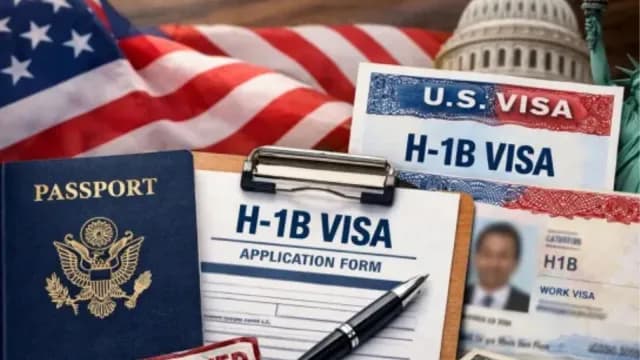
Trump Extends $100,000 H-1B Fee As Court Battle Tests Presidential Power
Extension keeps disputed fee in place through Sept. 2027 as courts examine presidential authority over H-1B visas
 Staff WriterSep 21, 2026, 12:12 PM
President Donald Trump has extended for another year a controversial requirement that employers pay $100,000 when seeking to bring certain H-1B workers into the United States, prolonging a policy whose legal foundation is being challenged in federal court.
The extension, announced on September 18, keeps the restriction in place until September 21, 2027, subject to limited national-interest exceptions. But the move does not settle the central legal question: whether the president and executive agencies have sufficient authority under immigration law to impose such a substantial payment without specific congressional legislation.
That question has become increasingly important as the administration pursues a broader restructuring of the H-1B programme. Alongside the $100,000 measure, the Department of Homeland Security has proposed a separate $103,265 fee for cap-subject H-1B petitions. The two measures are legally distinct, but together illustrate the administration's attempt to make H-1B recruitment substantially more expensive while steering the programme towards higher-paid and higher-skilled workers.
A Policy Caught Between Executive Action And Judicial Review
The original $100,000 requirement was introduced by presidential proclamation in September 2025. It restricted the entry of certain H-1B workers unless the relevant petition was accompanied or supplemented by the payment.
The administration argued that the measure was necessary to address what it described as abuse of the H-1B system, particularly the use of lower-paid foreign labour by some IT staffing and outsourcing companies. The White House has maintained that the programme should supplement rather than replace American workers and that higher costs would discourage lower-wage recruitment.
The legal challenge, however, goes beyond whether the policy is desirable or effective. It centres on whether the executive branch can use presidential immigration powers to impose what employers and challengers regard as an exceptionally large financial condition on access to a visa programme created by Congress.
A federal judge in Massachusetts ruled in June 2026 that the government's implementation of the $100,000 payment requirement was unlawful and vacated the relevant agency guidance. The administration appealed to the US Court of Appeals for the First Circuit, leaving the broader dispute unresolved.
The extension therefore creates an unusual situation. The administration has formally continued the presidential restriction while the legal mechanism used to implement the payment remains under judicial scrutiny.
The Real Legal Issue Is Authority
The significance of the litigation lies partly in the size of the payment. Traditional H-1B government fees are measured in thousands of dollars, whereas the new requirement represents a $100,000 payment for qualifying cases.
That difference raises a fundamental question about the boundary between immigration regulation and congressional control over federal revenue.
The administration relies on sections 212(f) and 215(a) of the Immigration and Nationality Act, provisions giving the president authority to restrict the entry of certain foreign nationals. The September 2026 proclamation again invokes those provisions as the legal basis for restricting entry unless the payment is made.
The challengers' position, by contrast, has focused on whether those provisions authorise the government to impose such a substantial financial burden as a condition of entry into an existing visa programme.
That distinction could matter well beyond H-1B visas. If the courts ultimately accept broad executive authority to impose major financial conditions through presidential immigration proclamations, the decision could influence how future administrations use executive powers in other immigration programmes.
If the courts reject that approach, the administration could face pressure to seek congressional legislation for a permanent fee of this magnitude.
Employers Face More Than One H-1B Cost Increase
The $100,000 requirement is no longer the administration's only attempt to increase the financial cost of H-1B hiring.
In August, DHS proposed an additional $103,265 fee for all H-1B petitions subject to the annual cap, including petitions eligible for the US advanced-degree exemption. The proposed fee would be separate from the $100,000 payment and would be based on a different statutory authority.
DHS says the proposed fee would recover part of the costs incurred by federal agencies in administering the immigration system. The department estimates that applying the fee to an expected 85,000 cap-subject petitions could generate about $8.8 billion annually.
Importantly, the $103,265 charge is only a proposal. It is not currently a fee that employers must pay.
That distinction is critical for employers planning recruitment. The legal status of the $100,000 payment, the proposed $103,265 fee and other H-1B reforms are different. Treating them as one measure risks obscuring the separate legal and regulatory processes involved.
The Administration Is Changing Selection As Well As Cost
The fee strategy is only one part of the administration's broader H-1B policy. For fiscal year 2027, DHS has introduced a weighted selection system intended to give greater weight to higher-paid and higher-skilled positions. The White House says the system is designed to move the programme away from lower-wage recruitment and towards workers it considers more highly skilled.
The administration points to changes in registration patterns as evidence that the strategy is working. According to the White House, the largest IT staffing and outsourcing firms reduced their combined H-1B registrations from 24,946 to 2,055, a 92% decline. It also reported an increase in registrations involving beneficiaries with US master's degrees and a larger share of selections corresponding to the two highest wage levels.
Those figures demonstrate a significant change in filing behaviour, but they do not by themselves establish the wider economic consequences of the policy.
A decline in registrations from particular employers can reflect several factors, including the financial cost of sponsorship, changes in corporate hiring strategies and expectations about future immigration rules. Similarly, a higher proportion of high-wage registrations demonstrates a change in the composition of the applicant pool but does not necessarily establish the policy's long-term effect on wages, productivity or employment.
India Faces Particular Exposure
The changes have particular significance for India because Indian-born workers constitute the largest group among approved H-1B beneficiaries, although the policies themselves are not India-specific.
The importance of Indian professionals to the programme means that changes in fees, selection and entry requirements can have consequences for technology companies, outsourcing businesses and professionals moving between India and the United States.
The administration's policies could encourage some companies to reconsider where particular functions are performed. Reuters has reported that major H-1B users have responded to the changing environment by expanding operations outside the US, including in India. That creates a potentially important economic trade-off.
A policy intended to discourage employers from replacing US workers with lower-paid foreign labour could simultaneously encourage companies to locate more work outside the United States. In such a scenario, the effect would not necessarily be a simple transfer of jobs from foreign workers to American workers; some functions could instead move offshore.
The eventual economic impact will therefore depend not only on how many H-1B petitions are filed but also on how companies redesign their workforce and investment decisions.
Legal Uncertainty Could Become A Business Cost
For employers, perhaps the most immediate consequence is uncertainty. Companies making multi-year hiring and investment decisions need to know whether the $100,000 payment will ultimately be enforceable, whether the proposed $103,265 fee will become final, and whether further changes will alter the economics of sponsorship.
The administration's extension provides policy continuity, but it does not provide legal certainty.
The court proceedings could ultimately determine whether the original payment survives. Meanwhile, DHS is pursuing a separate rulemaking that could create a substantial fee under a different legal authority.
That means employers may have to plan around several possible regulatory outcomes rather than one clearly defined cost.
The Broader Question For H-1B Policy
The dispute is therefore about more than a $100,000 payment. The H-1B programme was created by Congress to allow US employers to hire foreign workers for specialty occupations. The Trump administration is attempting to use executive authority, agency rulemaking and economic incentives to change how that programme operates without waiting for comprehensive congressional reform.
The administration argues that existing H-1B practices have allowed some employers to use the programme in ways that depress wages or displace American workers. Business groups and companies dependent on skilled international recruitment have argued that H-1B workers remain important to sectors facing shortages of specialised talent.
The courts are being asked to address the legal dimension of that policy dispute: how far executive immigration powers extend when their exercise imposes substantial financial consequences on employers and changes access to a programme established by statute.
That makes the litigation consequential even beyond the immediate fate of the $100,000 payment.
A Programme In The Midst Of Structural Change
The extension through September 2027 gives the administration another year to pursue its stated objective of reshaping H-1B recruitment. But the policy's future remains dependent on the courts and on the outcome of separate regulatory proceedings.
For employers, the emerging H-1B framework is becoming a combination of higher potential costs, wage-based selection and increased scrutiny of recruitment practices. For foreign professionals, particularly those seeking their first H-1B visa from outside the United States, the system is becoming more difficult to predict.
The administration has presented the changes as a way of restoring the programme's focus on highly skilled workers. The legal challenges, however, are testing a different proposition: whether the executive branch can achieve such a transformation through presidential and agency action, or whether some of the most consequential changes require Congress to act.
Until that question is resolved, the extension of the $100,000 requirement may provide another year of policy direction without providing the certainty that employers, workers and immigration lawyers need most.
For enquiries or further information, contact ask@tlr.ae or call +971 52 644 3004. Follow The Law Reporters on WhatsApp Channels.