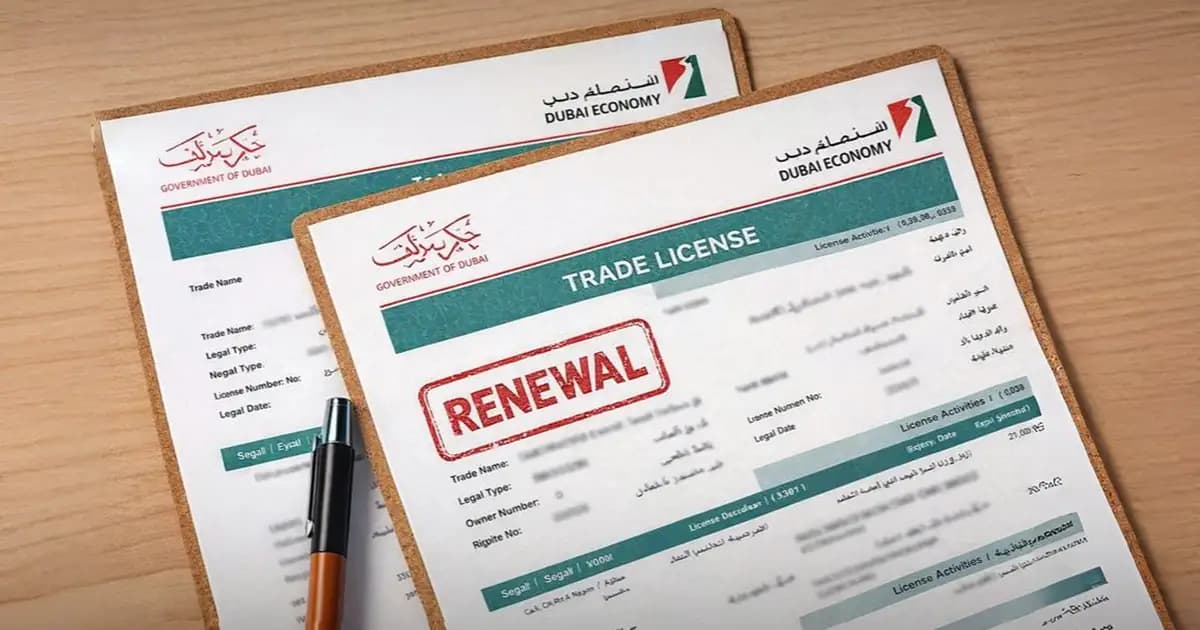
Licence Renewal Risks in UAE: How an Expired Trade Licence Can Trigger Legal and Financial Consequences for Businesses
Trade licence expiry in the UAE can lead to fines, frozen government services and significant business disruption.
 Gayatri NambyarJul 13, 2026, 10:42 AM
An expired trade licence does not simply place a company in a temporary state of inactivity. From the moment a licence lapses, the business falls into active non-compliance, exposing it to administrative penalties, suspension of government services, blocked visa and labour processing, banking restrictions, and, for mainland companies, potential sanctions under Federal Decree-Law No. 32 of 2021 on Commercial Companies and Cabinet Resolution No. 102 of 2022 on Administrative Penalties. Contracts entered into or performed during the period of expiry may also be challenged on the grounds that the company lacked the legal capacity to conduct business.
For businesses operating in the UAE, renewing a trade licence should therefore be regarded as a critical legal compliance obligation rather than a routine administrative task.
The Legal Significance of a Trade Licence
A trade licence forms the legal foundation that authorises a company to carry out its registered business activities, whether on the mainland under the relevant Department of Economic Development or Department of Economy and Tourism, or within a free zone under its respective regulatory authority. Once the licence expires, every function linked to the company's legal status can be affected, with consequences extending well beyond the licence itself.
A company operating without a valid trade licence may be viewed as acting outside its authorised capacity, creating significant legal and commercial risks. Counterparties, particularly banks, government entities and large corporate clients, routinely require an up-to-date trade licence before continuing business relationships. Many commercial contracts also require parties to maintain all licences necessary to perform their contractual obligations.
If a licence expires during the term of a contract, that representation may no longer be accurate. This can give the other party grounds to suspend performance, allege a contractual breach or, in some cases, terminate the agreement, even where the commercial relationship remains otherwise unaffected.
Employment and Immigration Consequences
The effects of an expired licence are equally significant for employment and immigration matters.
Under Federal Decree-Law No. 33 of 2021 on the Regulation of Labour Relations, employment relationships depend on an actively licensed employer holding valid work permits. Once a trade licence expires, the company's establishment card and labour file are typically frozen by the Ministry of Human Resources and Emiratisation (MoHRE) and the General Directorate of Residency and Foreigners Affairs (GDRFA).
This generally prevents the company from processing new employment visas, work permits, visa renewals and even routine visa cancellations until the licence is renewed. Employees whose applications are already in progress may also find themselves unable to complete immigration formalities, creating uncertainty for both employers and staff.
Banking Restrictions
Corporate banking facilities can also be affected when a trade licence expires.
UAE banks conduct ongoing customer due diligence under Federal Decree-Law No. 20 of 2018 on Anti-Money Laundering and Combating the Financing of Terrorism, which requires financial institutions to maintain current Know Your Customer (KYC) records for corporate clients.
An expired trade licence typically triggers an internal compliance review. Depending on the bank's internal policies, this may result in temporary restrictions on account operations, delayed or blocked fund transfers, requests for updated documentation, or suspension of certain banking services until a renewed licence is submitted. These measures may apply regardless of how long the banking relationship has existed.
Operational Disruptions
The impact of an expired trade licence extends beyond contracts, employment and banking.
Many operational permissions are directly linked to the company's trade licence, including municipal permits, sector-specific regulatory approvals, Ejari registrations for commercial premises and access to government digital portals.
Once the licence status changes to "expired", these linked services may be suspended automatically. Businesses often discover the problem only when they are suddenly unable to access government portals or renew related approvals, even before any inspection has taken place.
Administrative Penalties and Regulatory Action
Enforcement generally follows a progressive rather than immediate approach, although the applicable fees and grace periods vary between emirates and free zones.
For mainland companies, many Departments of Economic Development or Departments of Economy and Tourism provide a grace period—commonly around 30 days—during which businesses may renew without incurring late penalties. Once that period expires, late renewal charges are imposed and generally increase the longer the licence remains unrenewed, subject to the limits prescribed by the relevant authority.
Continued failure to renew may ultimately result in administrative suspension of the licence and, in more serious cases, cancellation proceedings initiated by the licensing authority.
Separately, companies incorporated under Federal Decree-Law No. 32 of 2021 may also face enforcement under Cabinet Resolution No. 102 of 2022, which establishes an escalating administrative penalties regime for breaches of the Companies Law. The framework generally provides for a written warning for a first violation, a financial penalty for a second violation, a doubled penalty for a third violation, and a tripled penalty together with temporary administrative closure of up to six months, renewable once, for a fourth violation.
Although these penalties apply to breaches of the Companies Law more broadly—including failures to maintain statutory records or comply with ownership requirements—they reflect the UAE's wider regulatory approach towards corporate compliance. Repeated violations are treated progressively more seriously, with temporary closure becoming an increasingly likely enforcement measure.
Government services may also be restricted in stages, beginning with suspended online portal access and blocked visa processing before escalating to broader compliance restrictions that may affect future dealings with licensing authorities.
Managing Renewal as a Compliance Priority
Because a missed renewal date can quickly affect contracts, employees, banking relationships and day-to-day operations, businesses should manage licence renewals as legal compliance deadlines rather than routine administrative formalities.
Companies should independently monitor their renewal dates instead of relying solely on government reminders, which may not always be issued in time. Renewal preparations should begin well in advance to resolve any prerequisite requirements, including valid Ejari registrations or tenancy agreements, updated shareholder documentation and any activity-specific regulatory approvals.
Where delays are unavoidable, businesses should proactively contact the issuing authority rather than waiting for enforcement action. Authorities generally view voluntary disclosure more favourably than discovering non-compliance during inspections or third-party verification.
Businesses should also review commercial contracts, financing arrangements and lease agreements for clauses requiring the maintenance of a valid trade licence, as these provisions may trigger additional contractual defaults if the licence expires.
Where a company has already missed its renewal deadline, legal advice should be sought before resuming business operations. Continuing to trade while a licence remains expired may itself constitute a separate regulatory violation, independent of the original failure to renew.
For any enquiries or information, contact ask@tlr.ae or call us on +971 52 644 3004. Follow The Law Reporters on WhatsApp Channels.