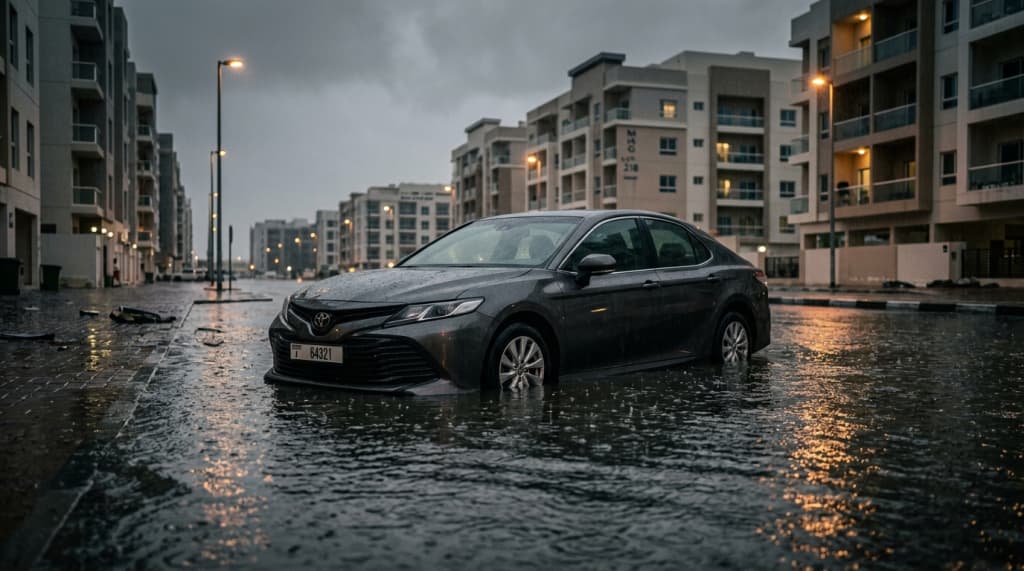
When Insurers Can Legally Reject Rain Damage Claims on Your Car and What UAE Policyholders Must Know About Their Rights
How comprehensive cover, policy exclusions, and contract terms determine whether rain-related damage is compensated under UAE law.
 Staff WriterApr 1, 2026, 8:09 AM
In the UAE, questions around whether insurers can deny claims for rain-damaged vehicles are governed by a combination of statutory provisions and standardised insurance frameworks. Motor vehicle insurance is regulated through the Unified Motor Vehicle Insurance Policy Against Loss and Damage, originally issued under Insurance Authority Board of Directors’ Decision No. (25) of 2016 (as consolidated on January 18, 2021), and currently administered by the Central Bank of the UAE.
This unified policy forms the legal foundation defining an insurer’s liability to compensate, or indemnify, an insured individual for damage to a vehicle. A key distinction under UAE insurance law lies in the type of policy held. Comprehensive motor insurance generally covers damage arising from external causes, whereas third-party liability insurance is strictly limited to damages caused to third parties and does not extend to the insured’s own vehicle. Therefore, if a car sustains rain-related damage and the owner holds only third-party cover, the insurer is legally entitled to reject the claim.
For policyholders with comprehensive insurance, the insurer’s obligations are more extensive but still subject to defined conditions. Under Chapter Two of the Unified Policy, insurers are required to indemnify the insured for loss or damage resulting from accidents, unless the incident falls within recognised exclusions. Although rain or water damage is not explicitly listed, it is typically interpreted as an external accidental event and is therefore covered in principle. However, coverage may still be denied if the policy contains specific exclusions relating to weather events, flooding, or natural disasters.
Insurance contracts in the UAE are also governed by Article 1026 of Federal Law No. (5) of 1985 on Civil Transactions, which defines insurance as a contractual arrangement between the insurer and the insured. Under this provision, the insured pays a premium in exchange for protection against specified risks, and the insurer is obligated to compensate only in accordance with the terms, conditions, and scope of coverage agreed in the contract.
The Unified Motor Vehicle Insurance Policy further clarifies circumstances under which insurers may lawfully refuse claims. Chapter Four of the policy outlines exclusions that limit liability. These include losses resulting from deliberate acts or intentional damage by the insured, use of the vehicle for purposes not covered by the policy such as racing or testing, operation by a driver without a valid licence, or use outside permitted geographical limits. Claims may also be denied where the insured has failed to take reasonable precautions to prevent damage. If rain damage occurs in a situation that falls within any of these exclusions, or where negligence can be established, the insurer may justifiably decline compensation.
However, where a comprehensive policy is in place and none of the exclusions apply, insurers are expected to honour valid claims. In cases where a claim is rejected, policyholders are not without recourse. They may escalate disputes to the Insurance Dispute Resolution Committee under the Central Bank of the UAE, accessible through the Sanad (formerly Sandak) platform.
Ultimately, whether a rain damage claim is accepted or denied depends on the nature of the policy, the presence of applicable exclusions, and the specific contractual terms agreed between the insurer and the insured. While insurers are entitled to reject claims under clearly defined legal grounds, policyholders also retain the right to challenge such decisions and seek redress where coverage has been unjustifiably denied under UAE insurance regulations.
For any enquiries or information, contact ask@tlr.ae or call us on +971 52 644 3004. Follow The Law Reporters on WhatsApp Channels.