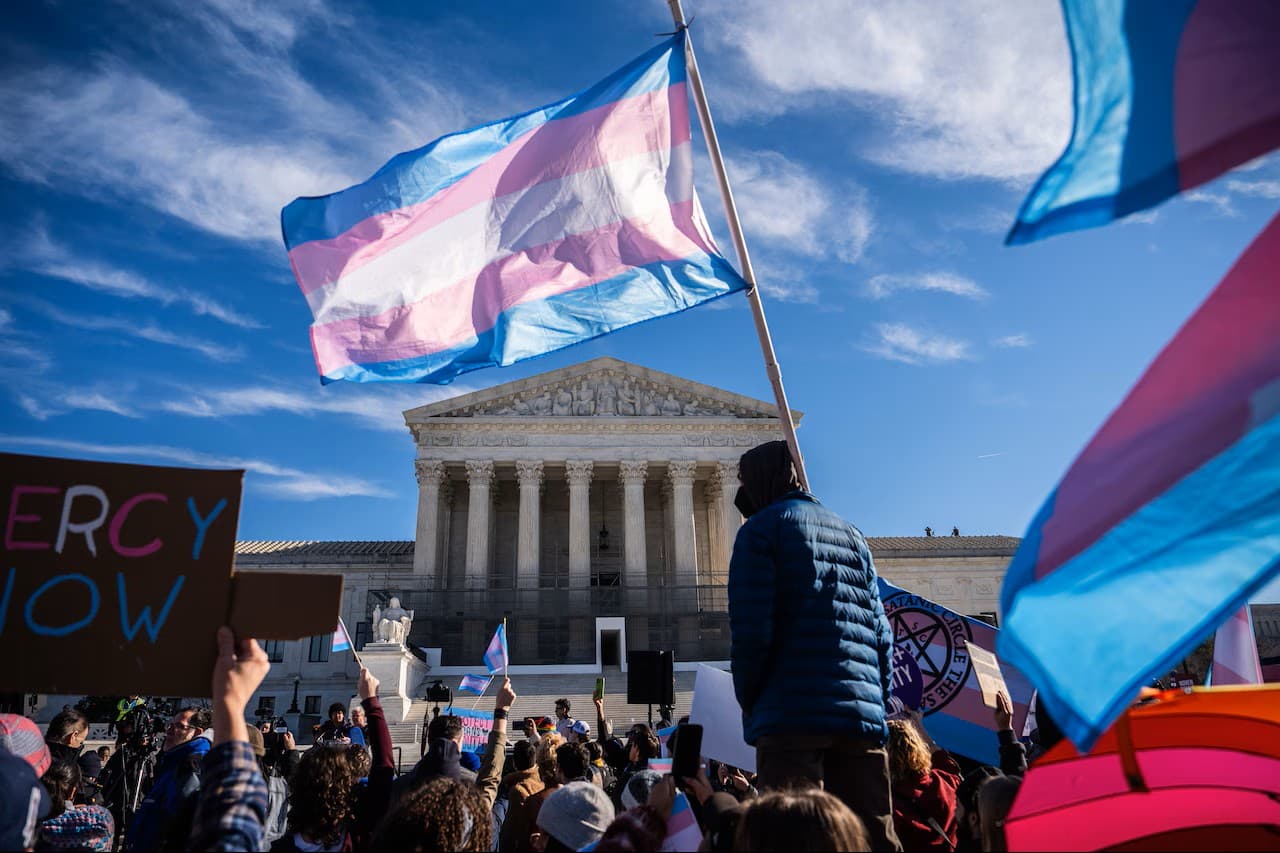
US SC Signals Support for State Bans on Transgenders in School Sports
Conservative justices hint at a narrow ruling upholding Republican-led state laws, while leaving liberal states such as California untouched -- for now.
 Staff WriterJan 14, 2026, 12:56 PM
The US Supreme Court on Tuesday appeared poised to uphold conservative state laws that bar transgender athletes from competing on girls’ school sports teams, although any ruling is likely to be limited in scope and may not immediately affect liberal-leaning states such as California.
Idaho, West Virginia and 25 other Republican-led states argue that eligibility for school sports should be determined by biological sex at birth. They contend that allowing biological males to compete in girls’ sports is unfair, particularly in events such as track and field or swimming. “Biological males are, on average, bigger, stronger and faster than biological females,” lawyers for West Virginia told the court.
Transgender rights advocates have successfully challenged these laws in lower courts, arguing that they amount to unconstitutional discrimination and violate Title IX, the 1972 federal law credited with expanding opportunities for girls’ and women’s sports.
During three hours of oral arguments, however, the court’s conservative majority suggested it was inclined to reverse those rulings. Justice Brett M. Kavanaugh indicated support for a cautious, incremental approach rather than a nationwide rule.
“Given that about half the states allow transgender girls and women to participate and about half do not, why would we at this point jump in and constitutionalise a rule for the whole country?” he asked.
Such an approach would mean that a ruling in favour of West Virginia and Idaho would not automatically change the law in California and more than a dozen other Democratic-led states that prohibit discrimination based on gender identity. California law takes the opposite approach, allowing K-12 students to participate in school sports based on gender identity rather than sex assigned at birth, under legislation signed by former governor Jerry Brown in 2013.
Still, several justices signalled potential trouble ahead for those states. Chief Justice John G. Roberts Jr. and Justice Samuel A. Alito Jr. questioned how courts should define “sex” under Title IX. Alito asked how discrimination could be assessed “without knowing what sex means”.
Picking up on that theme, Kavanaugh suggested that states like California could face difficulties if Title IX is ultimately interpreted as separating athletes by biological sex rather than gender identity.
The political context also loomed large. President Donald Trump has vowed to protect women’s sports from transgender athletes, and his administration has joined the cases in support of West Virginia and Idaho. Government lawyers argued that while the Constitution allows states to exclude transgender girls from girls’ teams, it does not require them to do so -- a position even West Virginia’s solicitor acknowledged, noting that “there is enough room for California to make a different interpretation”.
Deputy Solicitor General Hashim Mooppan nevertheless said Democratic-led states were “violating Title IX”, though he urged the court not to resolve that issue at this stage.
A ruling upholding the state bans could embolden the Trump administration to withhold federal education funding from states that maintain inclusive policies. In June, the US Department of Justice warned California school districts not to comply with state law on transgender athletes, a directive rejected by State Superintendent Tony Thurmond, who said schools would continue to follow California law. That dispute is now being litigated, amid threats to cut off federal funding.
In response to practical concerns, the California Interscholastic Federation has adopted compromise measures in individual sports such as track and field. Transgender athletes are not permitted to displace biological females from qualifying spots; instead, the number of qualifiers is expanded. Similarly, if a transgender athlete finishes first, the top biological female is also awarded first place.
The case before the court centres on Becky Pepper-Jackson, now 15, who has fought to compete on her school’s track team in Bridgeport, West Virginia. Designated male at birth, she says she is the only transgender girl competing in the state and has faced protests and complaints.
Her lawyers said she was a slow runner in middle school, often finishing near the back, but has performed strongly in high school. State attorneys countered that in 2024 and 2025 she placed highly in multiple events, displacing biological female competitors at the state level.
Her lawyer, Joshua Block of the American Civil Liberties Union, argued that her success was due to training and effort, and noted that she received puberty blockers and gender-affirming hormone treatment that resulted in a typical female puberty. He said she therefore does not enjoy a biological advantage.
The conservative justices, however, appeared reluctant to engage with the medical questions surrounding puberty blockers, focusing instead on the broader legal definition of sex discrimination under federal law.
For any enquiries or information, contact ask@tlr.ae or call us on +971 52 644 3004. Follow The Law Reporters on WhatsApp Channels.