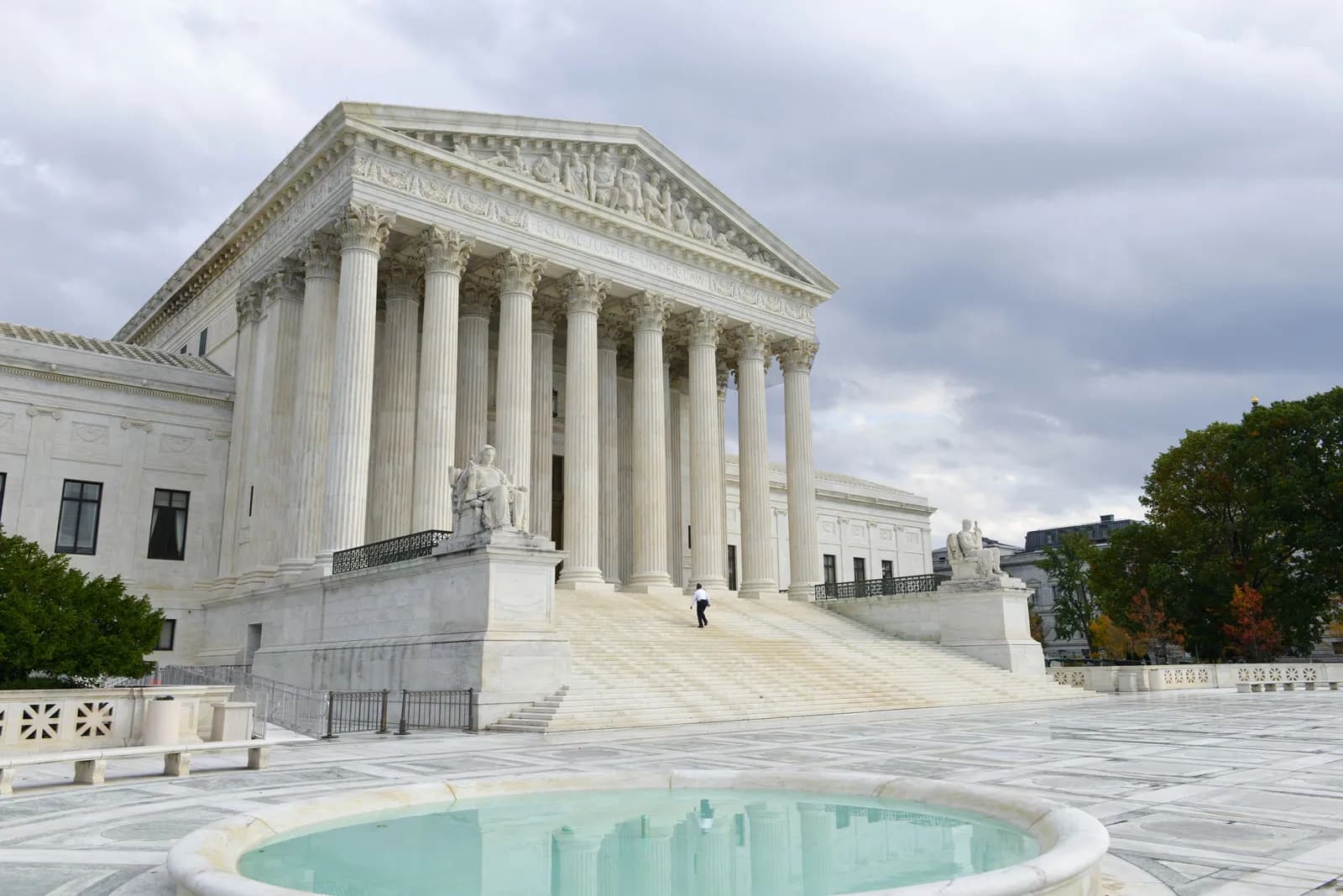
US Supreme Court Narrows Voting Rights Act in Landmark Ruling, Raising Bar for Minority Vote Dilution Claims
6–3 decision limits scope of Section 2, making it harder to challenge electoral maps and fuelling fears of partisan redistricting.
 Staff WriterApr 30, 2026, 10:25 AM
The US Supreme Court on Wednesday curtailed a key provision of the Voting Rights Act, making it harder for minorities to challenge electoral maps as racially discriminatory under the landmark civil rights law, in a victory for Louisiana Republicans and President Donald Trump’s administration.
In a 6–3 ruling driven by its conservative majority, the court upheld a challenge to an electoral map that had created a second Black-majority US congressional district in Louisiana. With November congressional elections looming, the decision could prompt Republican-led states to seek to redraw electoral maps in an effort to put at risk US House of Representatives seats considered safely Democratic.
The court’s liberal justices, civil rights leaders, Democratic lawmakers and some legal experts denounced the decision as severely undermining Section 2 of the Voting Rights Act, which Congress enacted to bar electoral maps that dilute the voting strength of minority groups.
“I love it,” Trump told reporters, adding that Republican-led states would now likely seek to reconfigure their voting maps.
Section 2 had gained greater significance as a bulwark against racial discrimination in voting after the Supreme Court in 2013 curtailed another part of the Voting Rights Act. Black voters tend to support Democratic candidates.
“This is a devastating and profound step backwards for American democracy,” Democratic Senator Raphael Warnock wrote on social media.
The Supreme Court has a 6–3 conservative majority. Wednesday’s ruling was authored by Justice Samuel Alito and joined by five other conservative justices, while the three liberal justices dissented.
Redistricting Battles
The ruling comes amid an intensifying battle across Republican-governed and Democratic-led states over the redrawing of electoral maps to reshape the composition of US House districts for partisan advantage ahead of the November elections. Trump and his fellow Republicans aim to retain the party’s razor-thin majorities in both the House and Senate.
The full impact of the ruling on the midterms was not immediately clear, though legal experts said states may attempt to enact new maps. Louisiana, where Black people make up roughly a third of the population, has six US House districts and is scheduled to hold a primary election on 16 May.
Louisiana Governor Jeff Landry indicated that he may suspend next month’s primary elections to allow state lawmakers to pass a new congressional map first, according to a Washington Post report. The announcement could come as early as Friday, a day before early voting is due to begin.
Section 2 was amended by Congress in 1982 to prohibit electoral maps that undermine minority voting strength, even without direct proof of racist intent. For more than four decades, plaintiffs could succeed in a Section 2 claim by demonstrating that a voting map had a racially discriminatory impact under what is known as the “results test”.
However, the court’s ruling effectively shifts the provision towards an “intent test”, experts said. Alito wrote that Section 2 must now be understood as enforcing the Constitution’s prohibition on intentional racial discrimination under the 15th Amendment.
“Only when understood this way does Section 2 of the Voting Rights Act properly fit within Congress’s 15th Amendment enforcement power,” Alito wrote.
The 15th Amendment, ratified in 1870 after the US Civil War, authorises Congress to pass laws ensuring that the right to vote is not denied “on account of race, colour or previous condition of servitude”.
Interpreting Section 2 to prohibit maps solely for failing to create a sufficient number of majority-minority districts would create a right not protected by the amendment, Alito added.
Trump, in a social media post, praised Alito as “brilliant” and described the ruling as “a big win for equal protection under the law”.
Former President Barack Obama said the decision allows state legislatures to redraw districts in ways that could “systematically dilute and weaken the voting power of racial minorities”, so long as such actions are framed as partisan rather than explicitly racial.
‘A Dead Letter’
Justice Elena Kagan, in a dissent joined by the other liberal justices, said the ruling rendered the Voting Rights Act “all but a dead letter” and warned of “grave” consequences.
“Under the court’s new view of Section 2, a state can, without legal consequence, systematically dilute minority citizens’ voting power,” Kagan wrote, adding that the majority had effectively “eviscerated” the law.
The Trump administration had backed the challenge to the Louisiana map, arguing for a higher threshold to prove violations of Section 2.
US House Speaker Mike Johnson, a Republican from Louisiana, said the court had reached the “obvious result”, while noting that the impact on the upcoming primary remained uncertain.
The Congressional Black Caucus condemned the ruling, warning that it could enable a nationwide effort to redraw congressional maps in ways that disadvantage Black voters while limiting legal challenges.
Warnock said the decision undermined protections fought for during the civil rights movement, including those championed by Martin Luther King Jr.
Redrawing Districts
Redistricting — the process of redrawing legislative district boundaries to reflect population changes measured by the decennial census — is typically carried out by state legislatures once every 10 years.
After Louisiana’s legislature initially adopted a map with only one Black-majority district following the 2020 census, a group of Black voters successfully challenged it in court. Lawmakers then approved a revised map adding a second such district.
That revised map was challenged by a group of voters who argued that it relied excessively on race, thereby violating the Constitution’s equal protection principle. A three-judge panel agreed in a 2–1 decision, which the Supreme Court has now upheld.
A lawyer for the challengers said the ruling restores the principle that voters should be treated equally as individuals.
The decision marks the latest in a series of Supreme Court rulings scaling back Voting Rights Act protections. In 2013, the court curtailed a provision requiring jurisdictions with a history of racial discrimination to obtain federal approval before changing voting laws.
Some legal experts warned that the latest ruling could make it nearly impossible to succeed in Section 2 claims.
“States can freely dismantle minority-opportunity districts as long as they frame their actions in partisan or political terms,” one expert said.
A recent Reuters/Ipsos poll found that 75 per cent of Americans believe race should not be considered when drawing congressional maps. However, about half of respondents — and a higher proportion of Black respondents — said communities sharing characteristics such as race should be represented within the same district.
For any enquiries or information, contact ask@tlr.ae or call us on +971 52 644 3004. Follow The Law Reporters on WhatsApp Channels.