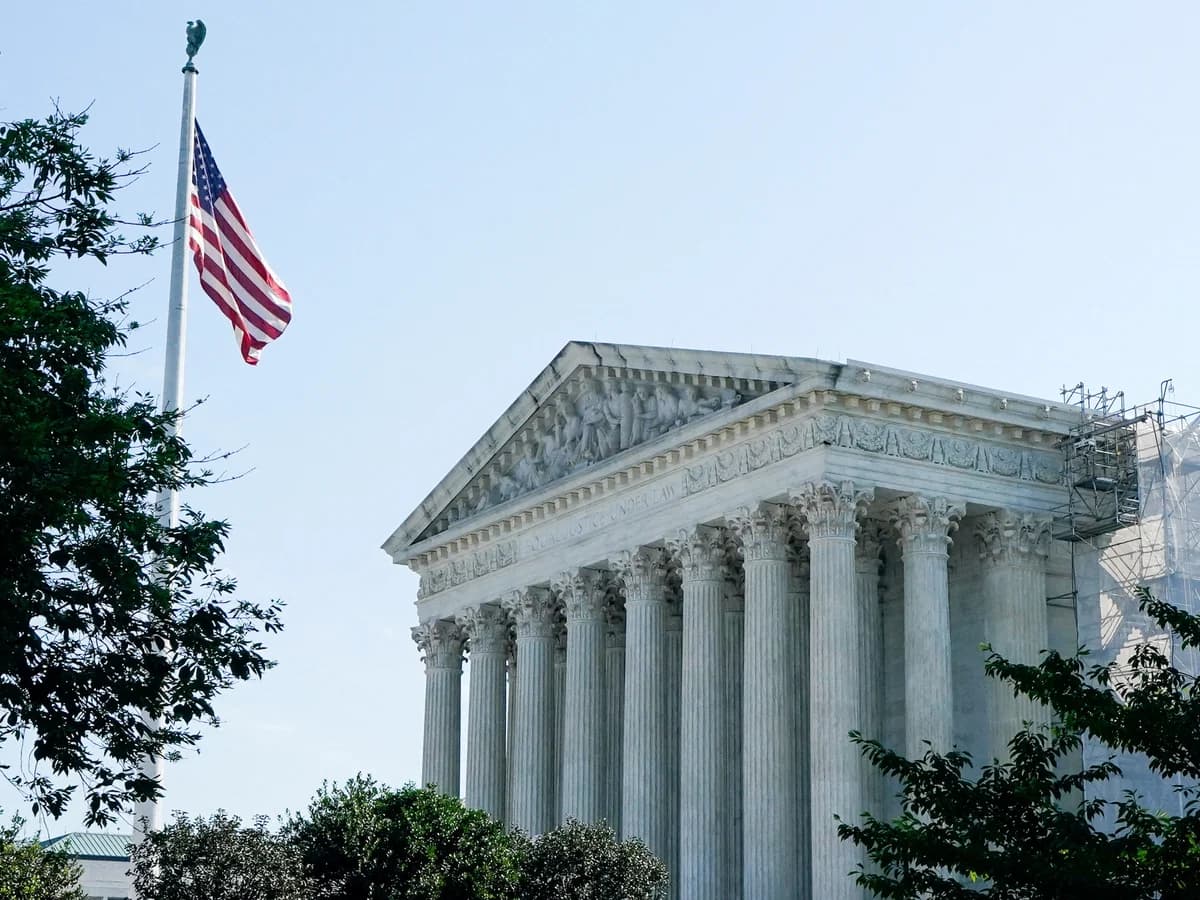
US Supreme Court Torpedoes Trump’s Global Tariff Regime — But the Trade War is Far From Over
Landmark ruling reins in executive power, reshapes global trade landscape — and hands India a strategic opening.
 Jeejo AugustineFeb 21, 2026, 10:24 AM
In a sweeping judgment that could redefine the balance of economic power in Washington and beyond, the United States Supreme Court has struck down President Donald Trump’s use of emergency powers to impose broad global tariffs. The decision — delivered in a closely watched ruling — is already reverberating across world markets, diplomatic circles and export-driven economies such as India.
The court held that Trump exceeded his legal authority by invoking the International Emergency Economic Powers Act (IEEPA) to levy sweeping import duties, stressing that tariff powers rest primarily with Congress unless explicitly delegated. The judgment dismantles one of the most aggressive tools of Trump-era trade policy and signals renewed judicial scrutiny over expansive presidential economic powers.
The Court’s Core Finding: Executive Overreach
At the heart of the case was a constitutional question: can a US president unilaterally impose wide-ranging tariffs under emergency economic powers? The Supreme Court’s answer was a firm no.
Chief Justice John Roberts, writing for the majority, concluded that IEEPA does not authorise the president to impose tariffs and that such taxing authority belongs to Congress unless clearly granted. The justices also leaned on the increasingly influential “major questions doctrine”, signalling that actions of vast economic and political significance require unmistakable congressional approval.
The ruling matters well beyond the immediate dispute. It reinforces the separation of powers in trade policy, places meaningful limits on the future use of emergency statutes for economic warfare, and curbs the practice of unilateral tariff diplomacy that had become a hallmark of Trump’s trade strategy. In effect, the court has drawn a constitutional red line around presidential trade powers.
Immediate Economic Fallout
The financial implications could be enormous. Analysts estimate that more than $175 billion in tariff collections could now be exposed to refund claims, depending on how lower courts handle implementation. Businesses that paid the duties are already preparing legal challenges seeking reimbursement, setting the stage for what could become one of the largest trade-related refund battles in US history.
Markets initially welcomed the decision, viewing it as a step towards restoring trade stability. However, the relief may prove temporary. Within hours of the judgment, Trump signalled his determination to continue pursuing aggressive tariff policies through alternative statutory routes, underlining that the broader trade confrontation is far from over.
Trump’s Countermove: Tariffs by Another Route
The administration is reportedly examining other legal pathways, including provisions under the Trade Act of 1974 and Section 301 investigations, to sustain pressure on trading partners. Trump has already indicated plans for a fresh round of global tariffs using different authorities, demonstrating that while the court has blocked one route, it has not dismantled the broader policy ambition.
This distinction is crucial. The ruling represents a major legal defeat for the White House’s preferred mechanism, but it does not eliminate the president’s ability to impose tariffs altogether. Instead, it raises the procedural and legal bar, forcing the administration to rely on more clearly defined statutory frameworks that may be slower and more vulnerable to challenge.
Why the Decision is a Global Game-Changer
The judgment restores a degree of predictability that had been missing from global trade since the escalation of tariff confrontations in recent years. Trump’s emergency tariffs created persistent uncertainty across supply chains, with businesses often struggling to anticipate sudden duty hikes. By insisting on clearer congressional authorisation, the court has nudged US trade policy back towards more rule-bound processes.
Equally significant is the blow to the doctrine of tariffs as an instrument of day-to-day foreign policy leverage. Trump had repeatedly used import duties as bargaining chips in negotiations with allies and rivals alike. The court’s intervention constrains that approach, potentially reducing the frequency of abrupt tariff shocks and strengthening multilateral trade norms.
The decision also fits into a broader judicial pattern of pushing back against expansive interpretations of presidential power. Legal scholars increasingly view the ruling as part of a trend in which courts demand clearer legislative mandates for actions with sweeping economic consequences. That trajectory could have implications beyond trade, touching sanctions policy, technology regulation and national security measures.
Why India Stands to Gain
Among major economies, India may emerge as one of the most immediate beneficiaries. With the tariff cloud temporarily lifted, a substantial portion of Indian exports to the United States could regain price competitiveness. Export-oriented sectors such as pharmaceuticals, engineering goods, textiles, gems and jewellery, and auto components are particularly well positioned to benefit.
For price-sensitive industries like garments and light engineering, even modest tariff reductions can translate into significant market share gains. The timing is also favourable for New Delhi. India is actively expanding manufacturing under its production-linked incentive schemes, seeking supply-chain diversification and positioning itself as a viable alternative to China in several sectors. Reduced tariff pressure from Washington strengthens India’s hand across all these fronts.
There is also potential for renewed momentum in bilateral trade engagement. If tariff barriers remain contained, US importers may increase sourcing from India, and stalled trade discussions between the two countries could regain traction. Over the medium term, the ruling could quietly accelerate India’s deeper integration into US supply chains.
Why the Celebration May Be Premature
Despite the apparent windfall, caution is warranted. The court did not ban all presidential tariffs; it only invalidated those imposed under IEEPA. Other statutory routes remain available to the administration, and several dissenting justices emphasised precisely this point.
Trump’s rapid move to explore replacement tariffs underscores the fragility of the current relief. New duties, even if narrower or more procedurally grounded, could still affect global trade flows. Litigation cycles may continue, and businesses may remain wary of sudden policy shifts.
Another major unresolved issue is the fate of previously collected tariffs. The Supreme Court has effectively opened the door for refund litigation but left the detailed implementation to lower courts. If large-scale repayments are ultimately ordered, the US Treasury could face substantial liabilities, while companies worldwide will rush to file claims. The resulting legal and financial complexity could take years to fully unwind.
Global Market Repercussions
In the short term, the ruling triggered cautious optimism in financial markets, with trade-sensitive sectors responding positively to the prospect of reduced tariff friction. However, analysts warn that the bigger story may be continuing uncertainty rather than durable clarity.
Investors are now closely watching whether newly structured tariffs will withstand legal scrutiny, how Congress might respond to the court’s rebuke, and whether affected countries will recalibrate their trade strategies. The risk is that the global trading system enters a prolonged phase of legal and policy tug-of-war rather than achieving a clean reset.
Over the longer term, the decision could mark the beginning of a structural shift in how US trade policy is formulated. Greater congressional involvement, narrower reliance on emergency powers, increased litigation over tariff authority and renewed pressure to align with multilateral trade norms are all plausible outcomes. Whether these trends take hold will depend heavily on political developments in Washington.
Is the Ruling Final?
From a legal standpoint, the Supreme Court’s interpretation of IEEPA is final and binding. The administration cannot revive the same tariff framework under that statute. However, the broader policy battle is far from settled.
The White House still retains several avenues, including Section 301 investigations, national security tariffs under Section 232, and the possibility of seeking fresh congressional authorisation. Each pathway carries its own legal risks and procedural requirements, meaning future tariff actions are likely to face closer scrutiny and potentially more litigation.
The Bottom Line
The Supreme Court’s decision is a historic rebuke of one of the most aggressive tariff strategies pursued by the Trump administration. It restores constitutional guardrails around trade policy and offers immediate breathing space to global exporters, with India standing to gain significantly in the near term.
Yet the ruling does not end America’s tariff battles. Trump’s swift pivot to alternative legal tools suggests that the struggle over US trade policy is entering a new and more complex phase. For India and the wider global economy, the message is clear: relief has arrived for now, but the era of tariff uncertainty is far from over.
For any enquiries or information, contact ask@tlr.ae or call us on +971 52 644 3004. Follow The Law Reporters on WhatsApp Channels.