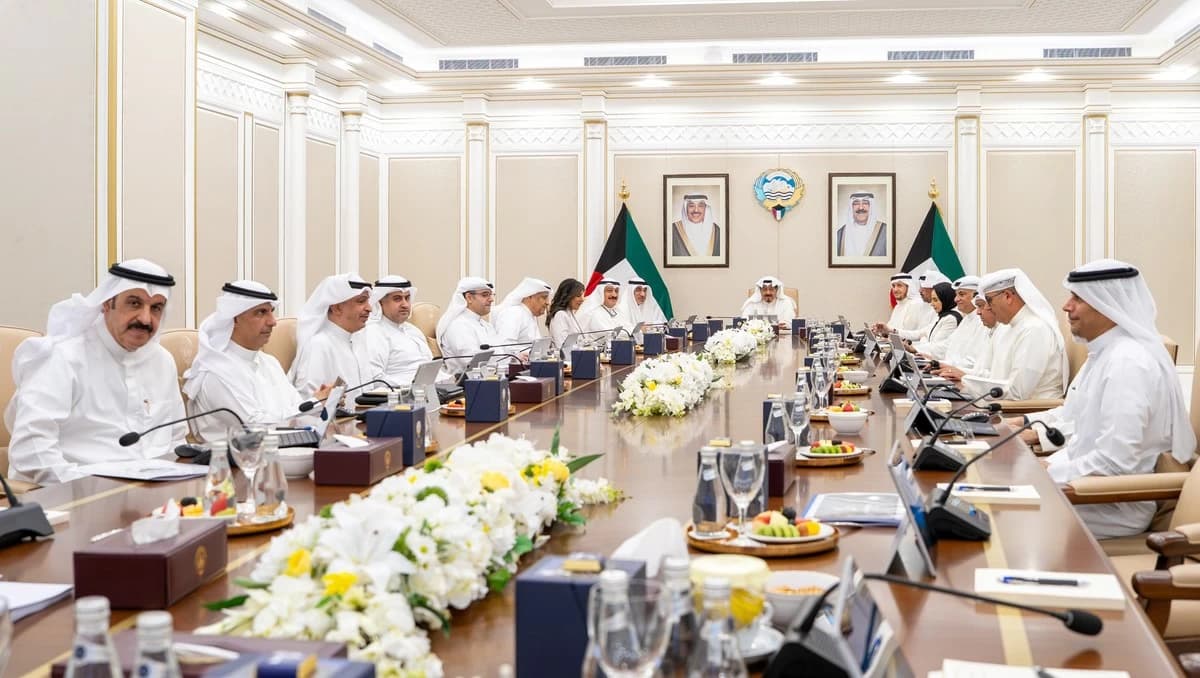
Kuwaiti Cabinet Approves Nationality, Judicial and Economic Court Reforms
Draft laws propose tighter nationality rules and specialised economic courts to speed up dispute resolution.
 Staff WriterSep 4, 2026, 10:07 AM
The Kuwaiti Cabinet has approved a package of draft legislative amendments covering nationality, the organisation of the judiciary, economic courts and the ranks of judges and Public Prosecution members, as part of efforts to modernise the legal framework and improve the efficiency of the justice system.
The decisions were taken at a Cabinet meeting chaired by Prime Minister Sheikh Ahmed Al-Abdullah. The Cabinet also approved arrangements for the opening of several new health projects in Kuwait, with the Prime Minister assigned to attend the ceremonies as the representative of the Amir, Sheikh Mishal Al-Ahmad Al-Jaber Al-Sabah.
Changes to the Nationality Law
The Cabinet approved a draft decree-law amending provisions of Amiri Decree No. 15 of 1959 concerning the Kuwaiti Nationality Law and referred it to the Amir for approval.
Under the proposed amendment to Article 14, nationality may be revoked from the children or descendants of a person who deliberately adds to his or another person's nationality file an individual who is not his child or descendant, where the matter is established through an investigation by the Supreme Committee for Investigating Kuwaiti Nationality or by a final court judgment.
The provision would apply where it is also established that the affected children or descendants were aware of the unlawful addition.
The Cabinet also approved an amendment replacing Article 19. Under the revised provision, the Minister of Interior would issue every Kuwaiti citizen with a certificate of Kuwaiti citizenship after verifying its validity in accordance with the law.
The certificate would be issued electronically, with the Minister empowered to establish the technical and technological requirements governing its issuance, storage and use, together with procedures for verifying its authenticity and cancelling or suspending its use.
The electronic citizenship certificate would have the same legal validity and effect as the existing paper certificate and would replace it for the purposes of applicable laws, decrees and regulations.
Another amendment would add a new paragraph to Article 7, providing that individuals who acquire Kuwaiti nationality through naturalisation would not be entitled to vote, stand for election or be appointed to any parliamentary body.
Reorganising the Judiciary
The Cabinet also approved a draft decree-law on the organisation of the judiciary, aimed at developing the judicial system, improving the efficiency of judicial work and strengthening safeguards for judicial independence and integrity.
The proposed legislation would update the rules governing the selection, appointment and promotion of members of the judiciary, while expanding and refining the powers of the Supreme Judicial Council and the rules governing its operations.
It would also strengthen mechanisms for judicial inspection, accountability and disciplinary action, while enhancing litigation guarantees and the rights of parties before the courts.
The draft law further updates the provisions governing the powers and functions of the Public Prosecution.
Among the proposed changes is a stronger role for the Public Prosecution in monitoring places of detention. The legislation would also introduce an integrated mechanism for unifying judicial principles established by the Court of Cassation, with the aim of promoting greater consistency and stability in the interpretation and application of the law.
The draft also provides for the regulation of trials and judicial procedures conducted electronically, reflecting technological developments and the growing use of digital systems in the administration of justice.
The Cabinet referred the draft decree-law on the organisation of the judiciary to the Amir.
It also approved a draft decree replacing the table attached to Decree No. 126 of 2018, which sets out the minimum periods judges and members of the Public Prosecution must serve in their respective ranks. The draft decree was likewise submitted to the Amir.
Economic Courts to Accelerate Dispute Resolution
In a separate move, the Cabinet approved a draft decree-law establishing specialised economic courts, seeking to bring Kuwait's dispute-resolution framework closer to modern regional and international practices and make greater use of technology in judicial proceedings.
The proposed legislation is designed to balance litigants' right to a full defence with the need to resolve economic and commercial disputes more quickly.
Under the draft, an economic judicial circuit and a designated judge would be assigned to hear cases falling within its jurisdiction. The allocation would also extend to the expert appointed to examine disputes before the court and the execution judge responsible for enforcing its judgments.
The proposed framework would streamline litigation by shortening certain procedural deadlines and introducing measures to prepare cases before they are referred to the competent judicial department.
It would also provide for earlier notification of litigants and allow parties to exchange pleadings, memoranda and supporting documents in advance, potentially reducing delays once proceedings formally begin.
Remote litigation would be activated as part of the proposed system, while safeguards would be maintained to protect the principle of confrontation between the parties and the right to defence.
The draft legislation also seeks to provide greater flexibility in the legal framework governing economic litigation, with the Cabinet identifying excessive rigidity in existing legislation as one of the shortcomings that the reforms are intended to address.
The Cabinet referred the draft decree-law establishing economic courts to the Amir for consideration and approval.
For enquiries or further information, contact ask@tlr.ae or call +971 52 644 3004. Follow The Law Reporters on WhatsApp Channels.