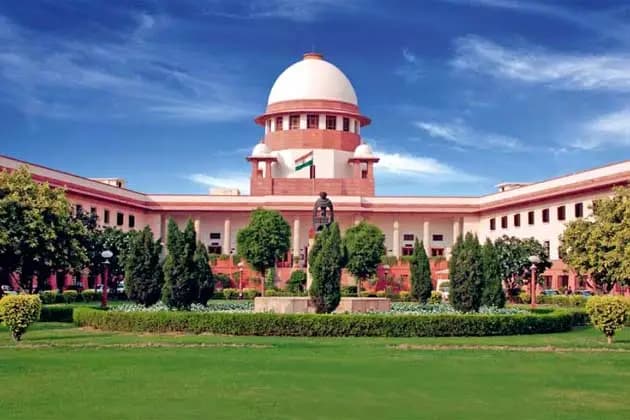
India Supreme Court Orders Nationwide Review of Private Universities
Top court seeks full disclosure on how private universities are set up, governed and regulated after Amity student claims discrimination over name change.
 Staff WriterNov 27, 2025, 11:31 AM
The Supreme Court has ordered a comprehensive, nationwide audit of private universities, directing the Union government, all States and Union Territories, and the University Grants Commission (UGC) to submit detailed disclosures on how such institutions are established, governed and monitored.
A Bench of Justices Ahsanuddin Amanullah and NV Anjaria said the exercise was necessary in the larger public interest to understand the statutory framework under which private universities operate and the benefits they receive from governments, including land allotments and administrative concessions.
The order came while hearing a petition filed by 23-year-old student Ayesha Jain, who accused Amity University of refusing to update her name in its records despite her providing all required legal documentation. She alleged that officials harassed her, barred her from classes and even taunted her after she changed her name to a Muslim one.
Jain said she had repeatedly approached the UGC and the Ministry of Education, but no corrective action was taken. Her petition stated that she lost an academic year as a consequence of the university’s conduct.
The dispute dates back to 2021, when she legally changed her name from Khushi Jain to Ayesha Jain and published it in the Gazette of India. After completing a certificate programme at Amity Finishing School under her new name, she joined Amity Business School in 2024 for an MBA (Entrepreneurship). However, the university allegedly refused to update her academic records, preventing her from attending classes or sitting for examinations.
Following multiple unanswered representations, she moved the Supreme Court in 2025. During earlier hearings, the Court criticised the university’s handling of the matter. On October 9, it directed Amity’s chairman and vice-chancellor to personally explain their position. On October 14, the Bench said the university had made a “mockery” of its orders after it attempted to offer ₹1 lakh as compensation. It then summoned Dr Atul Chauhan, President of the Ritnand Balved Education Foundation, and the Vice-Chancellor.
On November 20, both officials appeared before the Court and filed affidavits. Instead of closing the case, the Bench broadened its scope, noting that the issues raised had wider implications for the regulation of private higher education in India.
The Court sought details from all governments on the legal basis for the establishment of private and deemed universities, the benefits granted to them, and the identities and selection processes of those who manage these institutions. It directed that information on land allotments, statutory relaxations, financial concessions and governance structures be submitted in full.
The UGC was asked to explain the regulatory framework applicable to private universities and the mechanisms it uses to ensure compliance with statutory and policy requirements. The Court also sought disclosures on admissions processes, faculty recruitment, statutory salary payments, grievance redressal systems, and whether institutions claiming “no profit, no loss” status operate accordingly.
The Bench made clear that responsibility for the accuracy of these disclosures lies with the individuals filing them, warning that any suppression or misrepresentation would invite a strict view from the Court.
To ensure accountability, the Court directed that affidavits be personally affirmed by the Cabinet Secretary, Chief Secretaries of all States and Union Territories, and the Chairman of the UGC, without delegation.
The matter will next be heard on January 8, 2026, when the Court is expected to review the disclosures in detail.
For any enquiries or information, contact ask@tlr.ae or call us on +971 52 644 3004. Follow The Law Reporters on WhatsApp Channels.