UAE’s Latest Digital System Cuts Time For International Judicial Cooperation
ICAS speeds up extradition and mutual legal assistance while streamlining administrative procedures
 Staff WriterSep 30, 2026, 12:15 PM
International judicial cooperation is increasingly becoming a test of how quickly legal systems can exchange information, evidence and decisions across borders. For the UAE, the latest move to digitise that process is intended to address one of the most persistent obstacles in cross-border criminal investigations: administrative delay.
The UAE Ministry of Justice says its International Cooperation Assistance System, or ICAS, has reduced the processing time for some procedures from as much as seven days to five minutes. The platform, introduced in January 2026, has also reduced staff effort by about 80 per cent, while selected procedures have recorded efficiency improvements of up to 90 per cent.
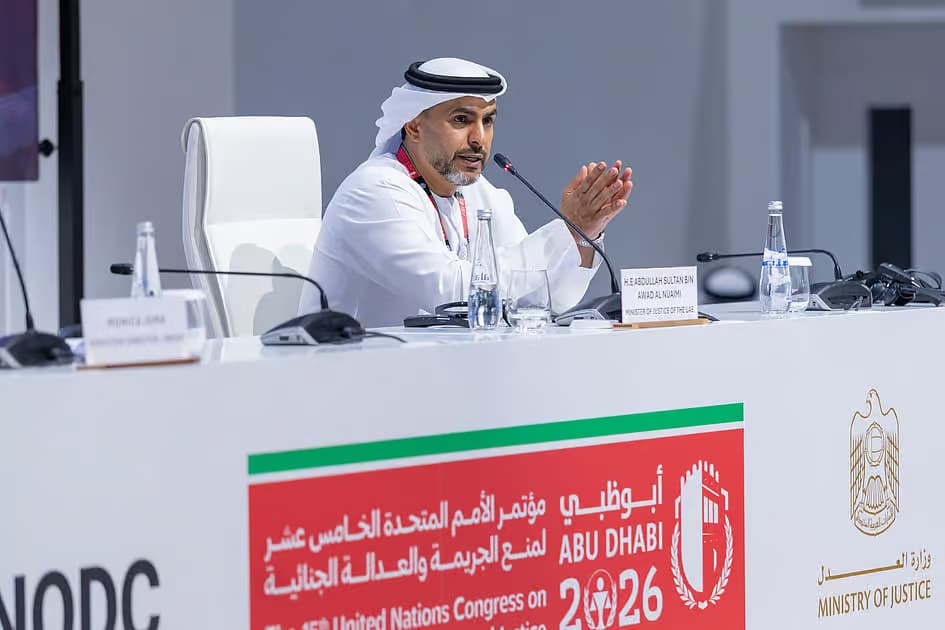
The figures were disclosed during the 15th United Nations Congress on Crime Prevention and Criminal Justice in Abu Dhabi, where international judicial cooperation has been among the issues under discussion. The Congress is being held from September 26 to October 1, 2026.
From Administrative Processing To Digital Workflow
The significance of ICAS lies not simply in replacing paper with electronic documents. The system restructures the administrative chain through which international cooperation requests are received, checked, referred and processed.
According to the Ministry, 141 administrative procedures have been consolidated into four standardised stages: submission of the request, verification, committee referral and electronic payment. Escalation stages have also been reduced from eight to three, with automatic referrals, electronic voting and archiving of decisions incorporated into the platform.
That approach is particularly relevant to mutual legal assistance, where a request may involve courts, central authorities, ministries, prosecutors and diplomatic channels in more than one jurisdiction. Removing unnecessary administrative stages can reduce the time between a foreign request being received and the competent UAE authority being able to act on it.
The Ministry's existing service information confirms that ICAS is used for judicial assistance requests, including the transmission of requests from competent courts to the UAE's central authority.
Faster Processing Could Matter Beyond The Paperwork
The more important measure of digitalisation is whether administrative efficiency translates into faster legal outcomes.
The UAE says complete mutual legal assistance requests are now executed in an average of 35 days, compared with international judicial cooperation guidelines that allow considerably longer periods of between 60 and 180 days. The average response time for voluntary extradition requests has also fallen to five days.
These figures matter because delays in cross-border cases can affect the preservation of evidence, tracing of criminal proceeds and the ability of authorities to locate and secure suspects. In financial crime investigations, for example, the value of information can diminish rapidly when assets are moved between jurisdictions.
The system therefore forms part of a wider shift in which judicial cooperation is being treated as an operational process rather than purely a diplomatic or administrative function.
Rising Demand Adds Pressure
The timing of the reform also reflects the growing volume of international cooperation requests handled by the UAE.
Incoming extradition requests increased by 235 per cent between 2021 and 2025, while mutual legal assistance requests rose by 244 per cent during the same period. The UAE now has more than 140 bilateral judicial cooperation agreements with 53 countries, with about 30 per cent concluded during the past five years.
The growth means that simply adding personnel to process requests would not necessarily provide a sustainable solution. Standardisation and automation offer another way of absorbing higher volumes while maintaining procedural consistency.
Technology Still Has To Serve Due Process
The move towards automated processing does not remove the legal requirements governing extradition or mutual legal assistance. Decisions still depend on applicable treaties, domestic law, judicial oversight and the requirements of the requesting and requested jurisdictions.
That distinction is important. Digital systems can accelerate the movement and verification of information, but they cannot replace the legal assessment required before evidence is disclosed, assets are restrained or an individual is extradited.
The UAE's Justice Minister, Abdullah Sultan bin Awad Al Nuaimi, has framed the system within that broader principle, saying international cooperation must allow criminal assets, money and evidence to be traced and recovered while maintaining the rule of law.
ICAS therefore represents more than a technology upgrade. Its longer-term significance will depend on whether faster administrative processing can be combined with consistent legal scrutiny, secure information exchange and effective communication between central authorities.
For a jurisdiction handling a rapidly expanding volume of cross-border requests, the ability to move a case through its administrative system in minutes could become increasingly important. The challenge now is ensuring that speed strengthens, rather than bypasses, the procedural safeguards on which international judicial cooperation depends.
For enquiries or further information, contact ask@tlr.ae or call +971 52 644 3004. Follow The Law Reporters on WhatsApp Channels.