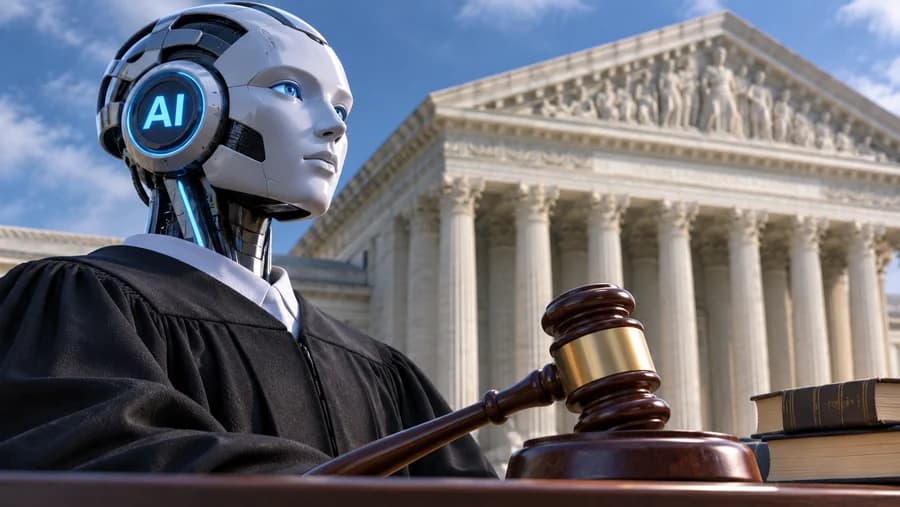

When the University of North Carolina School of Law held one of the first simulated trials featuring AI jurors last year, the bots achieved only moderate success in replicating their human counterparts.
In its latest experiment, the law school tested whether artificial intelligence could reproduce the reasoning of US Supreme Court justices, with similarly mixed results.
Students and faculty staged a simulated Supreme Court hearing on October 22, based on an actual case heard by the country's highest court in 2025. Three AI justices delivered a ruling during a campus conference focused on artificial intelligence.
“We weren't asking the question of, ‘Can AI replace the justices?’ because we don't think that's very likely,” said Nicole Downing, the law school's assistant dean for AI. “We were really interested in seeing if AI can reason in a way that's similar to what we see from published Supreme Court opinions.”
In terms of reaching a decision, the AI justices performed well, ruling in the same way as the actual court. However, the simulated oral arguments differed considerably from real-life proceedings, Downing said.
The AI justices posed questions and hypothetical scenarios to the law students arguing the case, but their interactions felt robotic. They did not interrupt or interject in the manner of real Supreme Court justices, she said.
The experiment comes as an increasing number of legal technology companies develop generative AI tools for judicial analytics and predicting case outcomes. Law students are also using the technology to prepare for moot court competitions and anticipate judicial questions, Downing noted.
The organisers of the event, titled “May It Please the Machine”, needed a Supreme Court case that was relatively straightforward and could be argued within a short period. They selected Monsalvo Velázquez v. Bondi.
The case concerned the 60-day deadline for voluntarily leaving the country when an individual faces removal proceedings, and whether the deadline should be extended to the following Monday if the 60th day falls on a Saturday.
Rather than attempting to replicate all nine Supreme Court justices, the organisers programmed three AI judges, each representing a distinct judicial philosophy. One represented the court's textualist or originalist wing, another its pragmatic approach, and the third its progressive perspective.
Rolando Rodriguez, a university data librarian, developed the three ChatGPT-based justices, which appeared on screens during the simulated oral arguments.
The AI judges were supplied with anonymised versions of the case's procedural history and legal briefs, along with relevant major court decisions, statutes, procedural rules and agency guidance. Each was also provided with opinions written by the Supreme Court justices whose judicial approaches they were designed to represent.
The actual case was decided by a 5-4 majority. Justice Neil Gorsuch wrote the majority opinion, holding that the deadline for voluntary removal should be extended to the next business day when it falls on a weekend or public holiday. Justices Clarence Thomas and Samuel Alito dissented.
The AI experiment produced a similar division. The progressive and pragmatic AI justices formed the majority, ruling that the deadline should be extended, while the textualist AI judge dissented.
Downing said the experiment demonstrated the potential value of artificial intelligence for lawyers and law students preparing oral arguments and anticipating the questions judges might raise during hearings.
“The most interesting take away for me is that we can see that AI reasons in a way similar to humans, but it doesn't yet act in a way that is similar to humans,” she said. “There's still this huge gap in it actually feeling human.”
For enquiries or further information, contact ask@tlr.ae or call +971 52 644 3004. Follow The Law Reporters on WhatsApp Channels.