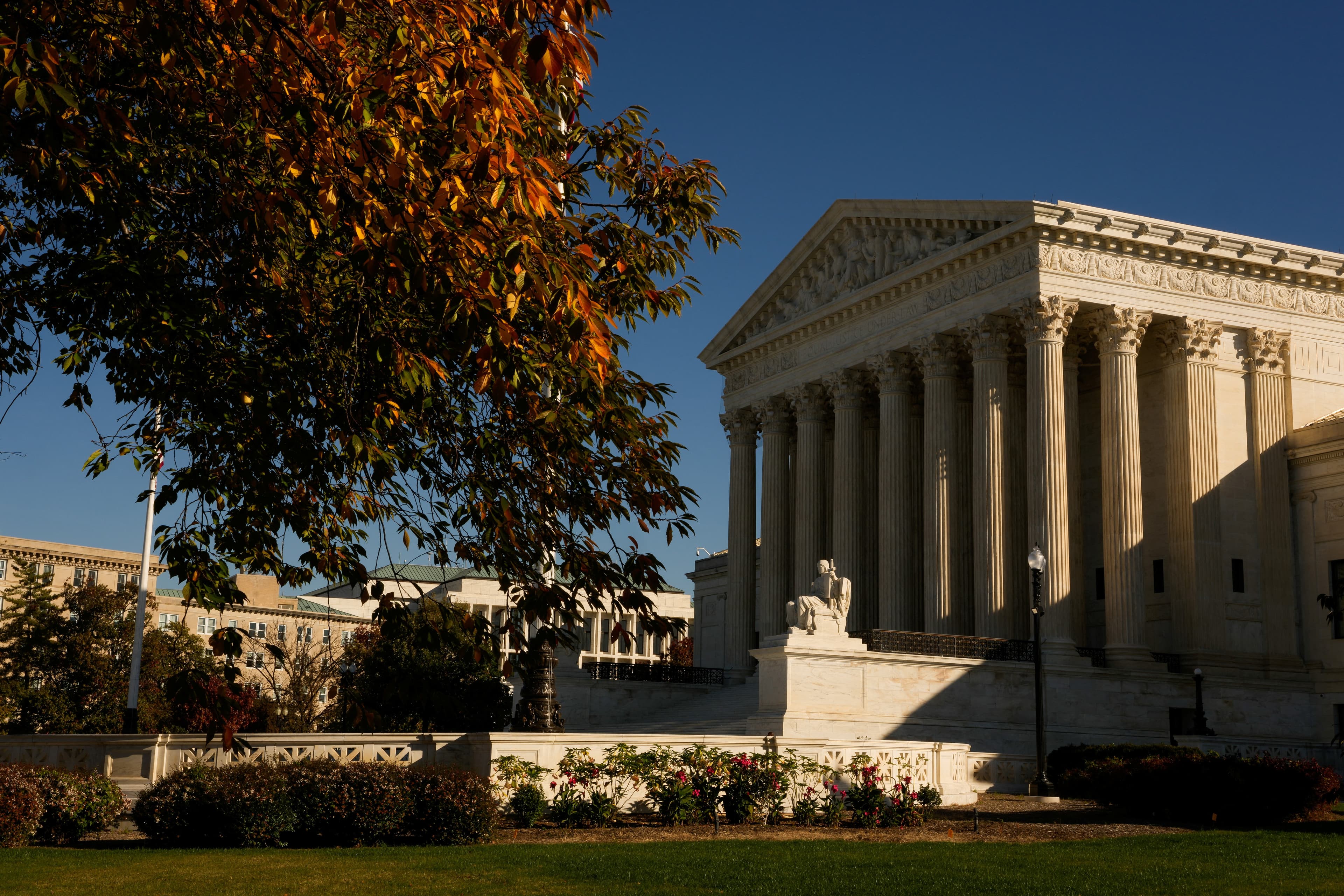

The US Supreme Court has allowed President Donald Trump's administration to proceed with the construction of barriers along the US-Mexico border in a remote region of West Texas that includes Big Bend National Park, fast-tracking one of the president's longstanding priorities.
The court granted the administration's emergency request on Monday to lift a federal judge's order halting construction in the region while a lawsuit challenging the project, brought by an environmental group and other parties, is pending.
The Republican president has long promoted the construction and reinforcement of barriers along the US-Mexico border as a central element of his sweeping immigration restrictions. However, his administration's plans to extend border infrastructure into the national park, about 250 miles (400km) south-east of El Paso, have faced opposition from local officials, conservationists and even some Texas Republicans.
"The government's interest outweighs any aesthetic, recreational and environmental harm alleged by respondents," the Supreme Court said in its brief ruling.
Liberal Justice Ketanji Brown Jackson was the only member of the court, which has a 6-3 conservative majority, to publicly dissent from the decision.
The lawsuit was filed by the Center for Biological Diversity, a river guide operating in the Big Bend area and a group seeking to preserve a historic church in Ruidosa, Texas. The group argues that the church's fragile adobe structure is threatened by the proposed border construction.
The plaintiffs challenged a series of waivers issued by the US Department of Homeland Security to accelerate the construction of roads and barriers in the Big Bend region. The waivers exempt the project from several environmental and conservation laws.
They were issued under a 1996 federal law intended to facilitate the construction of border barriers in areas experiencing high levels of illegal crossings along the southern border.
In its ruling on Monday, the Supreme Court said the legislation in question was likely to prevent judicial review of the claims brought in the lawsuit.
"The Trump administration and its contractors are hellbent on destroying one of America's greatest national parks, and the Supreme Court just gave them the green light," said Laiken Jordahl, the Center for Biological Diversity's national public lands advocate.
"This horrific decision clears the way for contractors to bulldoze pristine desert and dynamite canyon walls before the courts have even decided whether this destruction is legal," Jordahl said, adding that the Supreme Court was "signing off on the permanent destruction of the wildest place in Texas".
High Levels of Illegal Entry
Homeland Security Secretary Markwayne Mullin and his predecessor, Kristi Noem, both Trump appointees, issued the waivers between February and July after designating the region an "area of high illegal entry" requiring additional barriers to secure the border.
The administration has also argued that border officials have seized substantial quantities of drugs in the region and that drug cartels operate south of the area in Mexico.
According to the administration, most of the construction planned across the Big Bend sector, which stretches for more than 300 miles (480km), will take place on privately owned land. Big Bend National Park itself is expected to have a 17-mile (27km) non-contiguous vehicle barrier system, rather than the 30-foot (9-metre) pedestrian barriers planned for other sections of the border.
In August, the administration suspended construction in Big Bend following criticism from both Republicans and Democrats over the potential impact on the park's landscape and wildlife. Construction crews had already begun clearing land within the park for access roads and border security infrastructure, prompting protests and legal action aimed at stopping the work.
Ecologically and Culturally Significant Landscape
The challengers argued that, without the waivers, the project would have to comply with several federal laws, including the Endangered Species Act, the National Environmental Policy Act and the National Historic Preservation Act.
They described Big Bend as one of the most remote and ecologically and culturally significant landscapes in the United States, warning that the proposed construction could cause lasting damage to its natural environment and heritage.
The plaintiffs also argued that Mullin and Noem had exceeded their authority in issuing the waivers. They cited the so-called 'major questions' doctrine, which the Supreme Court has used to invalidate executive actions with substantial economic and political implications unless Congress has clearly authorised them.
The Supreme Court has previously relied on this doctrine to block some of the key executive actions of former Democratic president Joe Biden. In February, it also invoked the principle to strike down Trump's global tariffs, marking a significant legal setback for the administration.
In October, US District Judge Kathleen Cardone in El Paso blocked the border construction project.
Cardone ruled that the waivers lacked clear authorisation from Congress and violated the major questions doctrine. She also pointed out that Big Bend had, by a considerable margin, the lowest rate of migrant apprehensions along the entire US-Mexico border.
"Therefore, if the Big Bend Sector is an area of high illegal entry, so is every other sector, and the waiver authority would apply to the entire US-Mexico border," the judge said.
The US Department of Justice challenged Cardone's ruling before the Supreme Court, describing it as baseless.
"The secretary's waiver authority reflects a crystal-clear, indisputably valid express delegation from Congress that the executive has used for decades to expedite border-wall construction," the administration said in its filing.
For enquiries or further information, contact ask@tlr.ae or call +971 52 644 3004. Follow The Law Reporters on WhatsApp Channels.