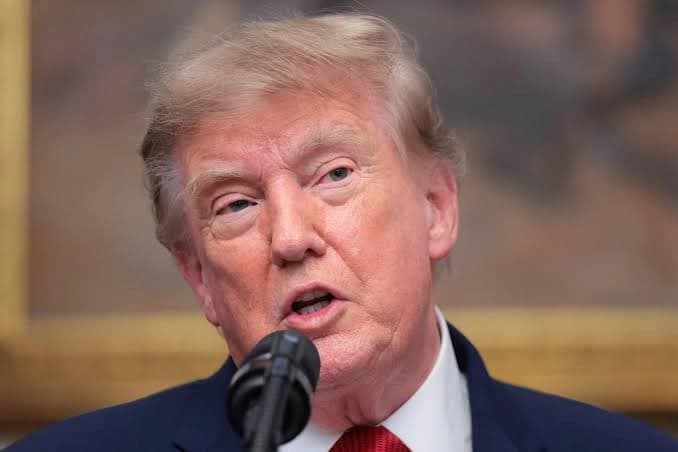
Trump Loses Bid to Move Criminal Hush Money Case to US Federal Court
Judge rejects his attempt to move his NY conviction to federal court, as he presses a presidential immunity claim.
 Staff WriterAug 31, 2026, 9:50 AM
A federal judge on Friday denied Donald Trump's attempt to move his already-decided New York state hush money case to federal court, dealing a setback to the US president's effort to overturn his criminal conviction.
Manhattan-based US District Judge Alvin Hellerstein's ruling came after a three-judge panel of the 2nd US Circuit Court of Appeals directed him to take a closer look at how the Supreme Court's July 2024 decision granting Trump broad immunity from prosecution affected the New York case.
Trump is seeking to overturn his May 2024 conviction for concealing a $130,000 hush money payment to porn star Stormy Daniels, whose claim to have had a sexual encounter with him could have upended his 2016 presidential campaign.
Jurors convicted Trump, a Republican, on 34 felony counts of falsifying business records in a case brought by Manhattan District Attorney Alvin Bragg.
Trump has denied Daniels' claim and defeated Democrat Hillary Clinton in the election. He is also asking a New York state appeals court to void his conviction.
A spokesman for Trump's legal team said the Supreme Court decision and other legal precedents require Bragg's "witch hunt" to be "immediately overturned and dismissed".
Trump Presses Immunity Claim
The Supreme Court's decision in Trump vs United States held that presidents are immune from prosecution for official acts, and that prosecutors cannot use evidence of official acts even in criminal cases involving private conduct.
Trump has argued that the ruling should invalidate his hush money conviction because jurors heard evidence from his first term in the White House, including testimony from former White House communications director Hope Hicks.
Hellerstein rejected Trump's bid to move the case in September 2024, agreeing with Bragg that the case involved private conduct and that Trump had waited too long to seek the transfer.
The judge had denied a similar request by Trump following his March 2023 indictment.
But in an unsigned decision on Thursday, the appeals court panel said Hellerstein had not adequately considered whether Trump vs United States represented a "change in controlling law" that could justify Trump's late attempt to move the case to federal court.
"Explaining only that 'nothing in the Supreme Court's opinion affects (the) previous conclusion that the hush money payments were private, unofficial acts, outside the bounds of executive authority,' the court bypassed what we consider to be important issues bearing on the ultimate issue of good cause," the panel said.
The appeals court said Hellerstein should review whether the disputed evidence "relates to acts taken under colour of the Presidency" and then determine whether Trump had "diligently" sought to move the case.
Bragg argued that Trump should not have waited nearly two months after the Supreme Court decision. Trump said the delay, which included an assassination attempt, was reasonable given the presidential campaign and other litigation.
The trial judge in the hush money case, Juan Merchan, sentenced Trump on January 10 to an unconditional discharge, meaning he faced no jail time or fine.
Merchan said the punishment, which leaves the conviction on the books, would avoid disrupting Trump's second term in the White House, which began on January 20.
Trump faced four criminal cases, but Bragg's was the only one to go to trial. Trump denied wrongdoing and pleaded not guilty in all four cases.
The three judges on the appeals court were appointed by Democratic presidents. Bragg is also a Democrat.
For enquiries or further information, contact ask@tlr.ae or call +971 52 644 3004. Follow The Law Reporters on WhatsApp Channels.